 fannie@nbtorch.com
 +0086-0574-28909873



Wholesale LED Flashlights 2026: High CRI vs. Lumens for B2B Buyers
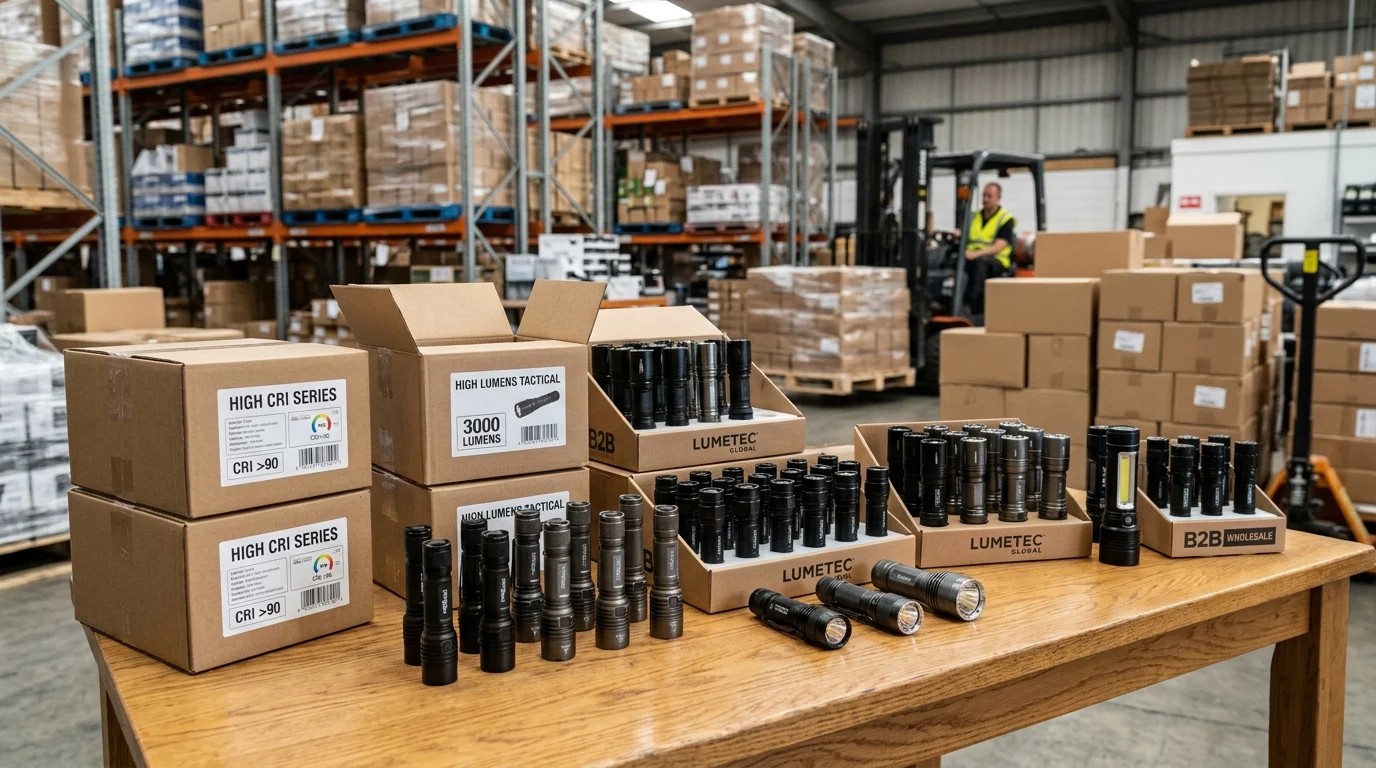
Why Wholesale LED Flashlights in 2026 Are Moving Beyond the Lumen Race
For years, the B2B lighting market has been locked in an arms race over raw brightness. When I first started working with procurement teams and distributors, the conversation always began and ended with one metric: how bright can we get this for under ten dollars? However, as we look toward 2026, the landscape for sourcing Wholesale LED Flashlights is maturing rapidly. Buyers are realizing that packing 10,000 lumens into a budget housing often leads to overheating, poor battery life, and ultimately, frustrated end-users.
Today, smart importers and retail buyers are shifting their focus toward usability, specifically prioritizing Color Rendering Index (CRI). High CRI means colors look true to life, which is critical whether you’re a mechanic inspecting wiring or a hiker identifying trail markers at dusk. The conversation has evolved from “how bright is it?” to “how well does it illuminate what I actually need to see?”
This shift isn’t just about enthusiasts debating specs on forums; it’s a fundamental change in how wholesale margins are protected. Products with exaggerated lumen claims are seeing higher return rates, eating into retailer profitability. By moving toward balanced specifications, we are seeing a much more stable sell-through rate across global markets.
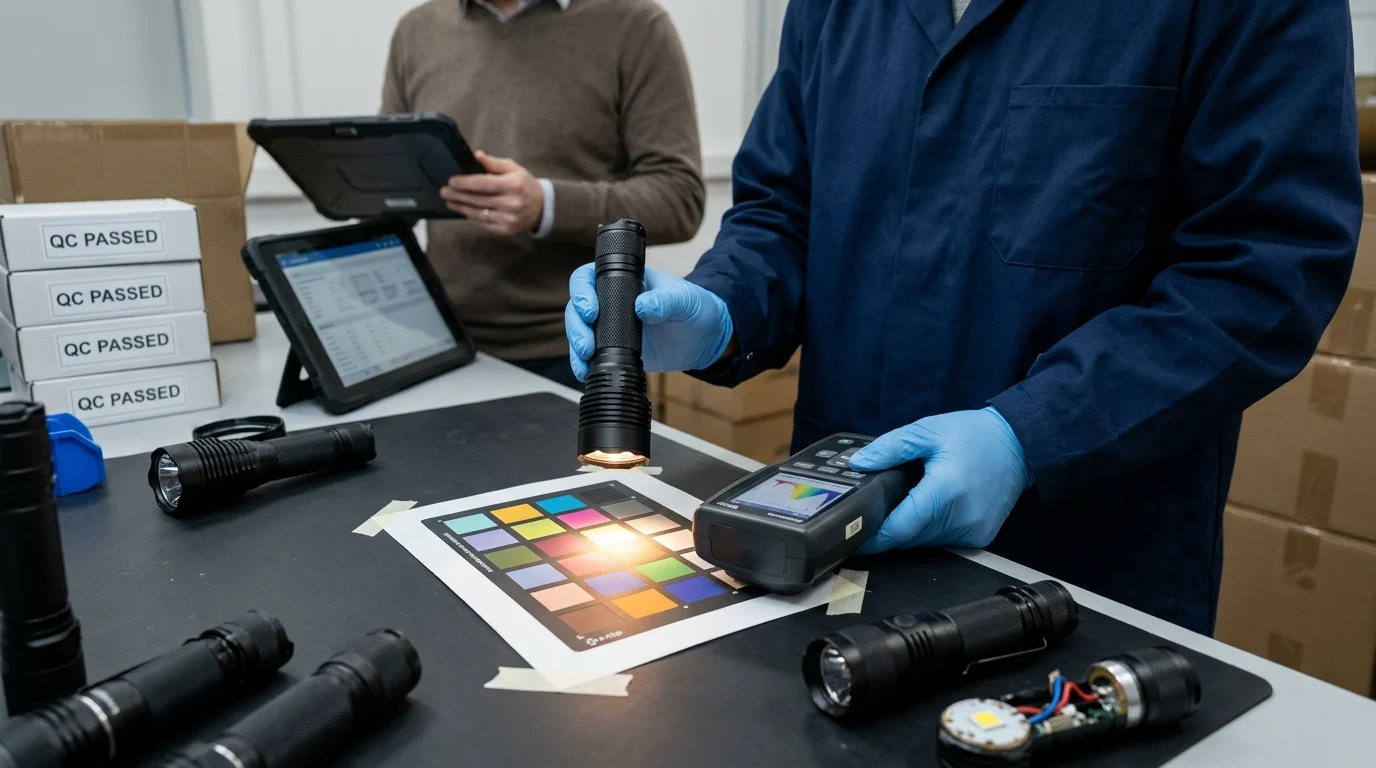
Market shift from brightness claims to application fit
The days of slapping a “100,000 Lumens!” sticker on a generic box are ending. Regulatory bodies and major retail platforms are cracking down on false advertising, forcing manufacturers to provide verifiable ANSI FL1 standard testing. Buyers now want flashlights tailored to specific applications—a floodlight beam for campsite illumination, or a tight throw for search and rescue operations.
Why CRI now matters for B2B buyers
B2B buyers are stocking up on High CRI Lighting because it drastically improves the user experience. A flashlight with a CRI of 90+ allows the human eye to distinguish subtle color differences, like the difference between a brown snake and a brown stick on a trail. For distributors selling to outdoor enthusiasts, medical personnel, or industrial workers, high CRI is now a non-negotiable selling point that justifies a premium price tier.
How sell-through, returns, and margin change buying priorities
When end-users buy a hyper-bright flashlight that overheats in three minutes and steps down to a dim glow, they return it. Every return is a direct hit to your margin. Procurement teams are now prioritizing sustained output and reliable heat dissipation over peak brightness. A flashlight that maintains a steady 800 lumens for two hours is proving much more profitable on the retail shelf than one that hits 4,000 lumens for thirty seconds.
Outdoor Advantage Summary: Moving beyond the lumen race means delivering reliable, sustained visibility. For outdoor activities like camping, hunting, or night hiking, high CRI and stable output ensure users can safely navigate terrain and identify wildlife without their equipment overheating or dying prematurely, making these models highly desirable for outdoor retail channels.
What B2B Buyers Should Define First
Before you send out a single Request for Quotation (RFQ), you need to get your spec sheet in order. I’ve seen countless wholesale deals go sideways because the buyer asked for “a bright flashlight” without defining the technical parameters. In the B2B world, ambiguity is the enemy of margin. You need to know exactly what you’re asking the factory to build or supply.
Defining your core requirements not only speeds up the sampling process but also prevents bait-and-switch scenarios with lower-tier suppliers. When you clearly state your required LED emitter brands, driver types, and battery configurations, factories know you are a professional buyer who understands the market. This immediately elevates the quality of the quotes you receive.
Furthermore, defining these specs allows you to segment your product lines. You might want a budget-friendly lumen monster for big-box impulse buys, while simultaneously sourcing a premium, high-CRI model for specialty outdoor stores. Let’s break down exactly what you need to define before you start sourcing.
Key terms: lumens, candela, CRI, CCT, and runtime
To source effectively, you must speak the factory’s language.
- Lumens: The total amount of visible light emitted.
- Candela: The peak beam intensity (how far the light throws).
- CRI: Color Rendering Index (how accurately colors appear).
- CCT: Correlated Color Temperature (warm vs. cool light, measured in Kelvin).
- Runtime: How long the light runs before dropping to 10% of its initial output.
How use case shapes product requirements
If your target market is warehouse security, you need high candela for long-distance throw and long runtime. If you are selling to backpackers, a lightweight Color Accuracy Flashlight with a warm CCT (around 4000K-5000K) is preferred because it cuts through fog and reduces eye strain during prolonged use in the woods.
Priority needs by channel and buyer segment
| Buyer Segment | Primary Focus | Ideal Spec Profile |
|---|---|---|
| Big Box Retail | Price & Shelf Appeal | High peak lumens, cool white CCT, blister packaging |
| Specialty Outdoor | Utility & Durability | High CRI, balanced throw/flood, neutral white CCT |
| Industrial/Tactical | Reliability & Throw | High candela, potted electronics, robust runtime |
Outdoor Advantage Summary: Accurately defining specs like CCT and CRI ensures your flashlights are perfectly tuned for nature. Warm, high-CRI beams penetrate outdoor moisture (fog/rain) much better than harsh, cool-white light, making them the ultimate tool for night-time trail navigation and campsite safety.
How to Compare High CRI vs High Lumens by Channel
Choosing between high CRI and high Lumen Output isn’t about finding a singular “best” flashlight; it’s about matching the tool to the distribution channel. When I consult with wholesale buyers, we always look at the end-user demographic first. The physics of LED technology dictate that you cannot have maximum brightness and maximum color accuracy from the same emitter without massive power consumption and heat generation.
Therefore, trade-offs must be made. High-lumen emitters are generally more efficient, meaning they produce more light per watt of electricity. High-CRI emitters sacrifice some of that raw output to produce a broader, more natural spectrum of light. Understanding this trade-off is crucial for positioning your products correctly on the shelf and setting the right expectations for your retail partners.
Let’s look at a brief text chart to illustrate the 2026 forecast demand by spec type across different retail channels:
- Chart: 2026 Forecast Demand by Spec Type
- E-commerce Marketplaces: 70% High Lumens / 30% High CRI (Driven by keyword searches).
- Specialty Outdoor Retail: 40% High Lumens / 60% High CRI (Driven by expert staff recommendations).
- Hardware/Automotive: 20% High Lumens / 80% High CRI (Driven by practical inspection needs).
Where high CRI performs best
High CRI is dominating channels focused on precision and outdoor immersion. Photography, medical inspection, automotive repair, and premium camping gear retailers are seeing massive growth in high-CRI models. Users in these sectors are willing to pay a 15-20% premium for light that doesn’t wash out colors.
Where high lumens performs best
High lumen models still dominate in mass-market e-commerce and tactical channels. When a consumer is scrolling through hundreds of listings, a higher lumen number often wins the click. Additionally, for search and rescue or property defense, raw output to overwhelm darkness (or an intruder’s vision) remains the top priority.
Trade-offs in price, battery draw, heat, and perceived value
High CRI LEDs (like the Nichia 519A) tend to generate more heat and draw more battery power to achieve the same perceived brightness as a standard low-CRI LED (like a standard Luminus SST-40). This means high-CRI flashlights often require better thermal management and higher-drain batteries, slightly increasing your Bill of Materials (BOM) cost.
How to align specs with customer demand
To align perfectly, audit your return reasons and customer reviews. If buyers complain about lights getting too hot or batteries dying too fast, pivot your sourcing toward lower-lumen, higher-efficiency emitters. If they complain that the light is “too blue” or “washes everything out,” it’s time to introduce a high-CRI SKU.
Outdoor Advantage Summary: Offering high-CRI options in your outdoor lineup gives you a massive competitive edge. Campers and hikers rely on accurate color rendering to cook food safely in the dark, read topographic maps accurately, and spot trail hazards, making high-CRI models an essential piece of premium outdoor gear.
Which Specifications Have the Biggest Impact on Cost and Margin
When you’re buying thousands of units, every penny counts. I always remind buyers that the LED chip itself is rarely the most expensive part of the flashlight. The real cost drivers are hidden beneath the aluminum shell. Understanding the Bill of Materials will give you incredible leverage during supplier negotiations and help you protect your landed margin.
Many buyers make the mistake of squeezing the factory purely on the final unit price. When you do this without specifying components, the factory will simply swap in cheaper batteries, lower-efficiency drivers, and thinner aluminum tubes to meet your target price. This inevitably leads to a higher failure rate.
Instead, you need to control the costs by engineering the product for your specific price point. If you need a $5 landed cost, you know you can’t use a premium constant-current driver and a branded 21700 lithium-ion battery. Let’s break down exactly where your money goes in wholesale flashlight manufacturing.
Core product specs that affect sourcing cost
The primary cost drivers are the battery capacity, the complexity of the driver circuit, the material and machining time of the housing, and the brand of the LED emitter. A Cree or Nichia emitter will cost more than a domestic Chinese equivalent, though the gap in quality is closing rapidly.
Battery, driver, and housing choices
Batteries are the single biggest variable. Including a generic 18650 battery versus a branded, high-capacity cell can swing the unit cost by $1 to $2. Drivers also matter: cheap direct-drive circuits are inexpensive but cause the light to dim as the battery drains. Constant-current drivers (Buck/Boost) cost more but provide flat, reliable output. Finally, Type III hard anodizing on the aluminum housing costs more than standard Type II but prevents scratching.
Customization options and MOQ impact
Custom laser engraving your logo usually has a low Minimum Order Quantity (MOQ), often around 100-500 units. However, if you want a custom body color (like olive drab green or desert tan) or a custom UI (user interface/mode spacing), factories will typically demand MOQs of 1,000 to 3,000 units to justify the setup costs and anodizing bath changes.
Packaging strategy for margin and freight efficiency
Bulky magnetic presentation boxes look great, but they destroy your freight margins. For wholesale, I strongly recommend custom-printed corrugated kraft boxes or slim blister packs. They protect the product, display well on retail pegs, and allow you to fit 30-40% more units onto a standard shipping pallet.
Outdoor Advantage Summary: By investing your BOM budget into robust drivers and high-capacity batteries rather than flashy packaging, you deliver a flashlight that won’t leave outdoor enthusiasts stranded in the dark. A well-machined, efficiently driven light is the ultimate survival tool for harsh weather environments.
How to Qualify a Wholesale LED Flashlight Supplier
Finding a factory on a B2B directory is easy; finding a reliable manufacturing partner takes work. Professional Sourcing requires a rigorous vetting process. I’ve learned that a supplier’s communication style during the quoting phase is a direct indicator of how they will handle a production crisis.
At our company, we pride ourselves on transparent communication and strict quality control, and we encourage buyers to hold all their suppliers to these high standards. You want a factory that pushes back on bad ideas. If you ask for a 10,000-lumen light powered by a single AA battery, a good supplier will tell you it’s physically impossible. A bad supplier will say “yes” and ship you garbage.
Qualifying a supplier means digging into their compliance history, their testing equipment, and their quality assurance protocols. Do they have their own integrating spheres to test lumens? Do they have aging rooms to test battery safety? These are the questions that separate the true manufacturers from the trading companies.
Compliance documents and test reports to request
Always request CE, RoHS, and FCC certifications upfront. More importantly, ask for IEC 62133 test reports for the lithium batteries they intend to include, and UN38.3 reports for shipping compliance. If they claim ANSI FL1 specs, ask to see the lab reports proving those lumen and drop-test claims.
Sample approval and quality control process
Never place a bulk order without a golden sample. Once you receive the sample, test it ruthlessly. Drop it, submerge it (if it claims IP68), and run it until the battery dies to check thermal throttling. Once approved, stipulate in your contract that the final mass production must match the golden sample’s exact BOM.
Production reliability and lead time checks
Ask for a detailed production schedule. A reliable factory will outline lead times for raw material sourcing, machining, PCB assembly, and final packaging. Standard lead times for custom OEM orders run 30-45 days. If a supplier promises a 10-day turnaround on a custom order, they are likely selling you off-the-shelf overstock.
Outdoor Advantage Summary: Partnering with a rigorously qualified supplier guarantees that your flashlights will survive real-world outdoor abuse. From IPX8 waterproofing that withstands river crossings to drop-resistant housings, top-tier manufacturing ensures the gear won’t fail when hikers and hunters need it most.
What Logistics and Channel Strategy Should Guide 2026 Purchasing
Getting the flashlights manufactured perfectly is only half the battle; getting them onto shelves profitably is where many B2B buyers stumble. Logistics for LED flashlights are uniquely complicated because of the lithium-ion batteries. Freight forwarders and customs agents are incredibly strict about battery shipments, and a single paperwork error can leave your inventory stuck in port for weeks.
As we move into 2026, supply chain agility is paramount. Ocean freight rates remain volatile, and import tariffs can shift overnight. Smart buyers are optimizing their logistics by rethinking how they ship and distribute. Sometimes, shipping batteries separately or sourcing batteries domestically while importing the flashlight hosts makes better financial sense.
Your channel strategy must dictate your logistics. If you are dropshipping for e-commerce, lightweight packaging is your primary concern. If you are supplying heavy-duty hardware distributors, pallet density and retail-ready display cartons are the priority.
Battery shipping, carton planning, and import factors
Lithium batteries must comply with UN38.3 regulations. You must ensure your factory packs the cartons according to dangerous goods standards (often requiring specific labeling and maximum weight limits per carton). To maximize freight efficiency, work with your supplier to design master cartons that perfectly cube out a standard shipping container, minimizing dead air.
Channel strategy for distributors, retailers, and private label buyers
Distributors need wide margins and reliable stock. Retailers need eye-catching packaging and barcoding (UPC/EAN). Private label buyers need low MOQs for custom branding to test new markets. Tailor your purchase orders to support these specific channel needs, ensuring you aren’t paying for retail blister packs if the lights are going into industrial tool kits.
Ways to protect landed margin and reduce risk
To protect your margins, negotiate Incoterms clearly—FOB (Free On Board) is generally best for maintaining control over your freight forwarder and shipping costs. Additionally, consider building a buffer stock of high-turnover models in a domestic 3PL (Third Party Logistics) warehouse to insulate your channels against sudden ocean freight delays.
Outdoor Advantage Summary: Efficient logistics mean you can keep critical outdoor gear in stock right before peak camping and hunting seasons. By mastering battery shipping and carton density, you ensure your retail partners never run out of reliable illumination tools when outdoor enthusiasts are gearing up.
FAQ About Wholesale LED Flashlights and Bulk Sourcing
When I speak with procurement teams, the same questions pop up repeatedly. The wholesale flashlight market is full of technical jargon, and cutting through the noise is essential for making profitable buying decisions.
Here is a quick rundown of the most common questions we field regarding bulk sourcing, spec prioritization, and avoiding the common pitfalls of overseas manufacturing.
Should buyers prioritize high CRI or lumens
It depends entirely on your customer base. Prioritize lumens (brightness) for security, tactical, and mass-market consumer channels. Prioritize high CRI (color accuracy) for specialty outdoor, automotive, medical, and photography channels where visual detail is more important than sheer distance.
Which certifications and test reports matter most
For the flashlight: CE, RoHS, and FCC are standard. For performance claims: ANSI FL1 standard testing reports. For the battery and shipping: IEC 62133 (safety) and UN38.3 (transportation). Do not skip the battery certifications, or your shipment will be rejected by freight forwarders.
How to reduce returns from overstated performance claims
Stop buying from suppliers who claim 100,000 lumens from a single 18650 battery. Base your marketing on verified ANSI FL1 test reports. Educate your buyers on “sustained output” rather than “peak output,” and ensure the UI (user interface) is simple enough that customers don’t accidentally lock themselves out of the light.
Outdoor Advantage Summary: Knowing the answers to these sourcing FAQs allows you to build an outdoor lighting catalog that consumers trust. By prioritizing realistic specs over fake lumen claims, you provide campers with dependable gear, resulting in glowing reviews and zero trail-side failures.
Key Takeaways for Final Supplier Selection

Selecting the right factory for your LED flashlights is a long-term investment in your brand’s reputation. The 2026 market will reward buyers who prioritize quality, verified specifications, and strategic logistics over the absolute lowest unit cost.
As you finalize your supplier choices, remember that a good factory acts as a partner. They should offer suggestions to improve your BOM, warn you about potential thermal issues with your chosen specs, and provide transparent updates during production. If you have to micromanage the factory to get a decent product, you have the wrong factory.
Keep these final takeaways in mind as you sign those purchase orders and prepare for a profitable year of sales.
Match product specs to channel needs
Don’t force a tactical thrower into a camping catalog. Use high-CRI emitters for close-up utility and high-lumen emitters for long-distance search. Tailor the battery capacity and user interface to the technical expertise of your end consumer.
Confirm compliance, quality, and customization fit
Verify all CE, RoHS, and battery safety documents before transferring any deposits. Order golden samples, test them rigorously, and ensure the supplier can meet your specific branding and packaging MOQs without cutting corners on the internal components.
Review landed cost, margin, and delivery reliability
Calculate your true landed cost by factoring in UN38.3 battery freight premiums and potential tariffs. Choose a supplier with a proven track record of hitting their lead times, ensuring your products arrive on shelves exactly when your seasonal buyers need them.
Outdoor Advantage Summary: Ultimately, selecting a top-tier supplier guarantees that your brand becomes synonymous with outdoor reliability. Delivering well-engineered, high-performance flashlights ensures that whether your customers are setting up a tent or navigating a pitch-black trail, they have the best possible light guiding their way.
Related Reading: Wholesale LED Flashlights
Key Takeaways
- Wholesale sourcing and supply-chain implications for Wholesale LED Flashlights
- Specifications, compliance, and commercial terms buyers should validate
- Actionable recommendations for distributors and procurement teams


