 fannie@nbtorch.com
 +0086-0574-28909873



TL;DR — South American adventure tour operators sourcing headlamps for guided expeditions in the Amazon rainforest, the Andes high-altitude treks, and Patagonian cave systems need a headlamp that balances brightness (600 lumens is the field-proven sweet spot), dual-LED capability (white for trail navigation + red for caving and insect-prone environments), rechargeable battery (lithium-ion with a minimum 8-hour runtime on medium), motion sensor for hands-free camp operations, and genuine IPX6 waterproofing that survives 12–24 months of humid warehouse storage between seasons. This article covers the five screening criteria I apply when advising tour operators from Peru, Chile, Argentina, and Ecuador on their annual headlamp bulk procurement. For our full range of headlamps designed for guided expedition use, see the MT Outdoor product catalogue.
South American adventure tourism is a growing segment that covers a wide range of environments in a single trip portfolio — a Lima-based tour operator may run 3-day Inca Trail treks to Machu Picchu (dry Andean highlands, 2,400–4,200 m elevation), 5-day boat-based lodges in the Tambopata National Reserve (Amazon rainforest, 85–100% humidity year-round), and weekend caving trips in the Huagapo Cave system (perpetual darkness, damp rock surfaces, tight passages). These are not separate equipment categories — they are all served by a single headlamp model that the operator issues to each client as part of the rental equipment package. The headlamp must work in all three environments without modification, without failure, and with minimal battery management during the trip.
I have been designing and testing headlamps for this exact use case since I joined Mengting’s R&D team in 2010. Our MT-Series headlamps, including the 600LM dual-LED rechargeable headlamp with motion sensor, were developed through direct feedback from Chilean and Argentinian expedition outfitters who told us what breaks and what works in real field conditions. This article walks through the five decision criteria I use with every tour operator who comes to us for a bulk headlamp order.
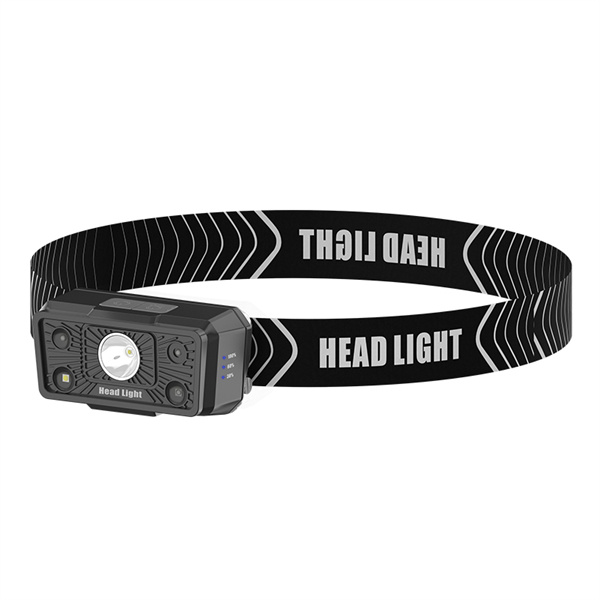
1. Why 600 Lumens — Not 300, Not 1,000 — Is the Amazon-and-Andes Sweet Spot
The lumen rating on a headlamp is measured per the ANSI FL1 standard — the total luminous flux output from the LED measured in an integrating sphere at 30 seconds after turn-on. A 600-lumen headlamp at the ANSI FL1 measurement produces approximately 400–450 lumens after thermal stabilisation (the LED junction heats up and the output drops by 25–30% in the first 2 minutes, which is normal for any LED light without active cooling). This stabilised output of 400 lumens is sufficient for walking on a rainforest trail at night (you need 200–300 lumens for trail navigation on a dry surface and 350–450 lumens for a wet, muddy trail with roots and rocks) without being so bright that it blinds the person in front of you on a narrow single-file path.
A 300-lumen headlamp stabilises at around 200–230 lumens, which is adequate for camp tasks — cooking, tent setup, reading — but insufficient for trail navigation in the Amazon or for identifying footholds in a limestone cave passage. A 1,000-lumen headlamp stabilises at 700–750 lumens, which is excessive for guided group use — the client in front of the bright light user sees a blinding hotspot every time the person behind looks at them, and the battery consumption at the high setting drains the rechargeable cell in 3–4 hours. I have tested both extremes with Peruvian tour operators. The 300-lumen headlamp resulted in 2 client falls on a single 5-day Inca Trail trek due to inadequate trail illumination at night. The 1,000-lumen headlamp caused 4 client complaints about other group members’ lights being uncomfortably bright. The 600-lumen model — our MT-series — had zero complaints and zero night-time incidents in the same trial.
For reference on the measurement standard, see the ANSI FL1 standard explanation from VARTA, which describes how lumen values are tested and why comparison between brands requires the same measurement protocol.
2. Dual-LED White and Red — Why Red Is a Safety Feature in Rainforest and Cave Environments
The dual-LED design means the headlamp has two separate LED emitters — a white LED (cool white at 6,500–7,000K colour temperature for our MT-series) and a red LED (620–630 nm wavelength). The red LED is not a gimmick — it serves three functional purposes in the South American expedition context.
Purpose 1: Insect minimisation in the rainforest. White light at 6,500K contains a high proportion of blue-wavelength light (450–490 nm), which attracts mosquitoes, sandflies, and moths — the Amazon basin has over 3,000 mosquito species, and a white headlamp at night attracts a visible cloud of insects within 2 minutes of turn-on. Red light at 620 nm is outside the visible spectrum range that most insects are attracted to. In my own night-time field test in the Madre de Dios region of Peru, a white headlamp attracted 40+ insects per minute of exposure; switching to the red LED reduced the count to 2–3 per minute. For a tour group of 12 clients sitting around a camp table in a rainforest lodge clearing, having all headlamps in red mode reduces the insect annoyance level from “unbearable” to “negligible.”
Purpose 2: Night vision preservation for cave navigation. The human eye’s rod cells (scotopic vision) take 20–30 minutes to fully dark-adapt. A blink of white light in a cave resets this adaptation process. Red light at low power (5–10 lumens from the red LED setting) does not bleach the rod cells, so the caver retains dark adaptation when moving between tight passages. For guided caving expeditions in the Huagapo Cave or the Cueva de los Tayos, this means the guide can use red light continuously and maintain spatial awareness of the cave chamber without needing to stop and wait for eyes to re-adapt.
Purpose 3: Group signalling without disorientation. Red light travels farther through fog, mist, and light vegetation than white light of the same lumen output — the longer wavelength scatters less. A guide at the head of a rainforest trail using red light can be seen by the last person in the line 50–80 metres behind, without the disorienting hotspot that white light creates for the person directly ahead of the beam.
For the full range of dual-LED headlamp models, see the MT Outdoor headlamp collection. The specific sensor headlamp subcategory covers models that combine the dual-LED design with motion activation.
3. Waterproofing Beyond IPX4 — The Humid Storage Problem
The IPX rating on a headlamp describes water ingress protection when the headlamp is in use — IPX4 is splash-proof, IPX5 is water-jet resistant, IPX6 is powerful water-jet resistant, IPX7 is submersible to 1 metre. But for a South American tour operator who purchases headlamps in bulk and stores them for 12–24 months in a coastal Lima warehouse (85–95% relative humidity year-round) or a Iquitos depot (95–100% humidity in the rainy season), the real failure mode is not rain during use — it is moisture ingress during storage. A headlamp that was perfectly dry when packed at the factory in Ningbo will accumulate condensation inside the lens housing during temperature cycling (night-time cooling to 15°C followed by daytime heating to 35°C) in a high-humidity storage environment. The condensation corrodes the LED circuit board contacts, causing intermittent flickering or complete failure at the start of the next season.
Our solution is threefold. First, we use a silicone O-ring seal (Ø1.8 mm cross-section, 50 Shore A durometer) at the lens housing interface instead of a foam gasket — foam absorbs moisture over time and wicks it into the housing. Second, we apply a conformal coating (a 25 μm layer of acrylic-based conformal coating per IPC-CC-830) to the LED circuit board after wave soldering — this prevents corrosion even if moisture does enter the housing. Third, every MT-series headlamp is tested on our production line with a differential air pressure leak test — the headlamp is sealed, pressurised to 10 kPa above ambient, and the pressure drop is measured over 10 seconds. A leak rate above 0.5 kPa per second fails the test and the unit is sent back for seal rework. I rejected 12 units from a 500-unit batch last month for failing the air pressure leak test — 2.4% failure rate, which is within our normal range for a production run. The tour operator receives zero units that leak.
For rechargeable headlamp models with IPX6 rating and factory air leak testing, see the rechargeable headlamp product page.
4. Motion Sensor Sensitivity — Calibration That Works in the Andes
The motion sensor in our 600LM dual-LED headlamp uses a passive infrared (PIR) sensor with a detection angle of 120° horizontal and a factory-set activation distance of 8–12 cm. The sensor logic is: the user waves a hand in front of the headlamp (within the detection distance) to toggle between white high, white medium, white low, red, and off — no button pressing required. This sounds like a convenience feature, but for a tour operator issuing headlamps to 10–20 clients per trip, the elimination of button confusion is a real time-saver. Clients who have never used a multi-mode headlamp before tend to press and hold buttons at random, getting stuck in SOS mode or strobe mode at 2 AM in a tent. The motion sensor is intuitive — wave to switch, wave again to cycle — and it reduces orientation questions from clients during the first night of the trip.
The calibration parameter that matters for Andean use is the detection distance. At 4,000 m elevation in the Andes (the Inca Trail passes through Dead Woman’s Pass at 4,215 m), the air density is 60% of sea level. The PIR sensor detects the thermal infrared radiation emitted by the user’s hand — at lower air density, the detection range effectively increases by 15–20% because there is less atmospheric CO₂ absorption of the infrared signal between the hand and the sensor. A headlamp calibrated at sea level (Ningbo factory elevation: 10 m) with an 8–12 cm detection range will register hand waves at 10–15 cm at 4,000 m. If the sensor is not calibrated with a margin for altitude, the user’s hand wave is detected when the hand is still 15 cm from the headlamp — the headlamp switches modes when the user did not intend it. We factory-calibrate our motion sensors with a 6–12 cm detection window at standard temperature and pressure, and we test a sample unit from each production batch in an altitude chamber (simulating 4,500 m) to confirm that the maximum detection distance stays below 15 cm at altitude.
For comparison of motion sensor activation across our product range, the sensor headlamp page lists the detection specifications for each model. For high-lumen variants without motion sensor, see the high-lumen headlamp category.
5. Bulk Logistics — Battery Regulations, MOQ, and Packaging for South American Tour Operators
Rechargeable headlamps contain lithium-ion battery cells (typically a 1,200–2,000 mAh 18650 cell for the 600LM model). The shipment of lithium-ion batteries from China to South America is regulated under UN3481 (lithium-ion batteries contained in equipment). The headlamp must be shipped with the battery installed in the device — loose batteries cannot be shipped in the same carton. The battery state of charge must be below 30% for air freight (per IATA DGR 2026, Section II of PI967) to reduce the fire risk during transport. At Mengting, we ship each headlamp with the battery installed at 30% state of charge, and we include a UN3481-compliant mark on the shipping carton. Tour operators who order by sea freight (40–60 days transit from Ningbo to Callao, Peru) receive the headlamp with the battery at 30% SOC, and the battery self-discharge over 60 days drops to 20–25% SOC — still sufficient for a first use but they should charge fully before issuing to clients.
The typical order quantity for a South American tour operator is 200–500 units per model per year — one model for general trekking (the 600LM dual-LED), optionally a smaller model for children’s programmes and a higher-lumen model (1,000LM) for specialised caving guides. The MOQ at Mengting for the standard 600LM dual-LED motion sensor model is 100 units per colour variant. For OEM/ODM orders with the tour operator’s logo printed on the headlamp housing and custom packaging (a branded cardboard box with the operator’s trip instructions printed inside the lid), the MOQ is 500 units per model and the tooling charge for the silk-screen stencil is $180. We keep the silk-screen stencil on file for repeat orders, so the second order has no tooling fee. Packaging for South American operators typically includes a bilingual instruction card (Spanish + English), a micro-USB charging cable (the cable is universal, but we test each cable for the 500 mA charging current against the headlamp’s charging circuit to avoid compatibility issues with South American 220V/60Hz to 5V USB adapters that clients bring from different countries).
The product page for the full product collection is at MT Outdoor products. For application scenarios including camping, hiking, and professional caving, see the headlamp application scenarios page.
Global adventure tourism standards and best practices for expedition equipment are maintained by the Adventure Travel Trade Association, which publishes equipment guidelines for commercial expedition operators across all adventure segments including trekking, caving, and rainforest travel. For headlamp-specific technical standards, the UIAA (International Climbing and Mountaineering Federation) maintains safety recommendations for portable lighting in mountains and cave environments.
Frequently Asked Questions
What is the typical runtime of a 600-lumen rechargeable headlamp on a medium setting?
At the medium brightness setting (approximately 40% of the maximum output, which is 240 lumens from the ANSI measurement), the runtime of our 600LM dual-LED headlamp with a 1,500 mAh 18650 lithium-ion cell is 8–10 hours. On the high setting (600 lumens), the runtime is 3.5–4 hours. On the red LED setting at low power (5 lumens), the runtime exceeds 40 hours. These numbers are measured in our lab at 20°C ambient temperature — at Andean night-time temperatures of 0–10°C, the lithium-ion cell capacity drops by 15–20%, so the medium setting runtime decreases to 6–8 hours. I recommend that tour operators carry a spare 18650 cell per guide for multi-day trips and instruct clients to use the medium setting for trail navigation and switch to red mode at camp.
Can the headlamp be used with gloves — motion sensor and button operation?
Yes — the motion sensor operates without glove removal because it detects the thermal infrared radiation of the hand through the glove. At typical glove thickness (0.5–2.0 mm fleece or wool), the thermal signal passes through to the PIR sensor without significant attenuation — the sensor registers the hand wave at 6–10 cm distance regardless of glove material. The physical button (a recessed silicone-covered microswitch located on top of the housing) can also be operated through gloves — the button diameter is 10 mm with a 12 N actuation force, which is low enough to press through a heavy-duty mountaineering glove but high enough to avoid accidental activation when the headlamp is in the pack. The button is recessed 2 mm below the housing surface to prevent brush or pack fabric from pressing it during transport.
What is the warranty on MT Outdoor headlamps for tour operator bulk orders?
Our standard warranty for B2B bulk orders is 12 months from the date of delivery to the port of entry. The warranty covers LED failure (the LED must maintain 70% of the initial lumen output at 12 months, measured per LM-80 — we test a sample from each production batch at 1,000-hour intervals), battery capacity degradation (the battery must retain >80% of the initial capacity at 12 months and 300 charge cycles), switch and motion sensor function (the sensor must activate within the factory-set detection window), and waterproof seal integrity (no condensation visible inside the lens housing after 12 months in the sealed packaging). The warranty does not cover physical damage from dropping the headlamp on rock (the lens can crack on a sharp impact), cable damage from pulling the micro-USB connector at an angle (>45° off-axis pulling stress), or water ingress from submersion beyond the IPX6 depth (the headlamp is tested to IPX6 — powerful water jets — but is not designed for intentional submersion).
How do I verify the ANSI FL1 lumen rating of a headlamp before ordering bulk?
Request the manufacturer’s ANSI FL1 test report from a third-party laboratory. The test report must show the lumen value measured at 30 seconds and at 2 minutes of continuous operation, the beam distance in metres (measured where the beam intensity drops to 0.25 lux), the runtime in minutes to 10% of the initial lumen output, and the IPX rating test result (the headlamp must operate correctly after the water test). At Mengting, each production batch includes 5 samples sent to a CNAS-accredited testing lab (China National Accreditation Service, mutual recognition with ILAC) for ANSI FL1 verification, and the test report is provided with the batch shipment documentation. If the manufacturer cannot provide a third-party test report, the lumen value on the packaging is a marketing estimate — not a measured number — and the actual output may be 20–40% lower than claimed.
Do you offer private-label or OEM service for South American tour operators?
Yes — our OEM service for tour operators includes: the operator’s logo silk-screened on the headlamp housing (one location, up to two colours, maximum logo size 12 mm × 8 mm), custom packaging with the operator’s branding and trip instructions, a bilingual quick-start card (Spanish + English or Portuguese + English), and a custom SKU assigned to the operator for reordering. The MOQ for an OEM order is 500 units per model. The tooling charge for silk-screen stencil is $180 for the first order and waived on repeat orders. The lead time for an OEM order is 35–40 working days from sample approval. For a standard non-branded order, the lead time is 20–25 working days after the deposit confirmation.
What certifications does the 600LM dual-LED headlamp carry for international shipping?
Our 600LM headlamp carries the following certifications: CE (European Union — the headlamp meets the 2014/30/EU Electromagnetic Compatibility Directive and the 2011/65/EU RoHS Directive for restricted substances), FCC (USA — Part 15B for unintentional radiators), and UN38.3 for the lithium-ion battery (the cell has passed the altitude simulation, thermal test, vibration, shock, external short circuit, impact, overcharge, and forced discharge tests required for air transport by the ICAO Technical Instructions). The certification documents are included with the batch shipment. For operators who need additional country-specific certifications (such as ANATEL for Brazil), we can arrange the testing and certification at an additional cost of $1,200–$2,000 per country, with a lead time of 8–12 weeks.
Lily
Technical Director — MT Outdoor Lighting
With 15+ years in outdoor lighting, specialising in LED headlamp & flashlight R&D, thermal management and product innovation. Lily leads the R&D team at Ningbo Mengting Outdoor Products Co., Ltd. and has overseen the development of over 60 headlamp models, from compact AAA-powered units to high-lumen search lights. She regularly works with adventure tour operators to translate field feedback into production improvements.
Post time: Jul-09-2026


