 fannie@nbtorch.com
 +0086-0574-28909873



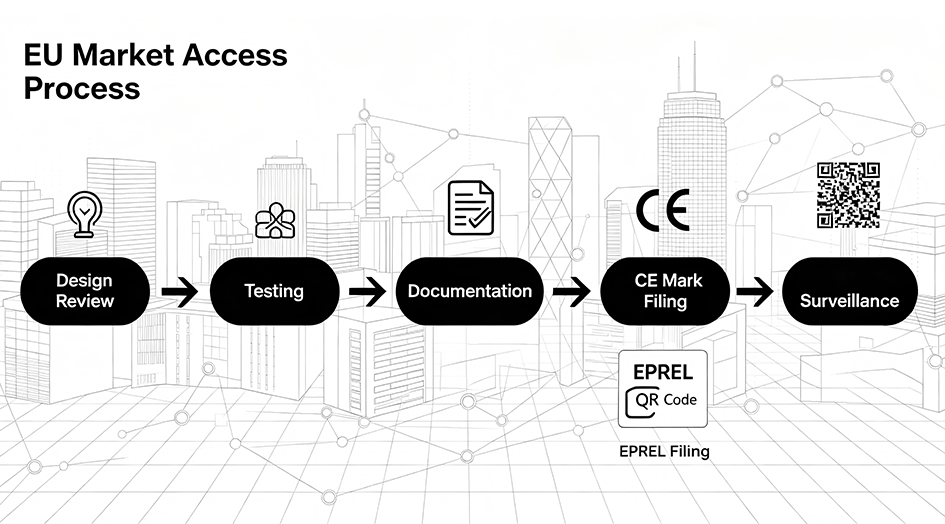
Master the 2026 updated EU regulations for outdoor headlamp manufacturing. Learn key compliance rules for optical safety, EMC, environmental standards, certification, and documentation to sell legally in the European market.
The European Union has rolled out sweeping regulatory updates for lighting products in 2026, bringing stricter, more precise compliance requirements for outdoor headlamp manufacturers worldwide. As one of the most popular portable outdoor lighting devices for camping, hiking, industrial work, and emergency rescue, outdoor headlamps fall under rigorous EU product safety, electromagnetic compatibility, environmental protection, and photobiological safety frameworks. For manufacturers, exporters, and brand owners targeting the European market, fully understanding and implementing these latest rules is no longer optional—it is a mandatory prerequisite for legal market access, avoiding costly customs detentions, product recalls, and regulatory penalties.
Unlike traditional household lighting equipment, outdoor headlamps face differentiated compliance standards due to their portable, wearable, and outdoor-specific usage scenarios, plus integrated smart functions like USB charging, Bluetooth control, and dimmable LED modules. The 2026 EU regulatory updates mainly revise technical thresholds for photobiological safety, glare control, electromagnetic interference, hazardous substance restrictions, and product database filing. This comprehensive guide breaks down all critical 2026 EU regulatory requirements for outdoor headlamp production, covering core certification standards, technical design specifications, production process controls, and post-market compliance obligations to help manufacturers achieve full EU market compliance.
1. Overview of 2026 EU Core Regulatory Frameworks for Outdoor Headlamps
In 2026, the EU has unified and upgraded multiple fragmented lighting product regulations, forming a systematic compliance system specifically applicable to portable outdoor LED headlamps. The updated rules supersede partial old-version standards and enforce stricter full-life-cycle supervision from product design, production, and testing to market filing and after-sales supervision. The core governing frameworks include updated industry-specific regulations and classic mandatory directives, which together constitute the bottom line of EU market access for outdoor headlamps.
First, Regulation (EU) 2023/2658, fully enforced on January 1, 2026, is the core updated regulation for LED lighting products. It mandates unified photobiological safety testing, standardized glare control thresholds, and upgraded thermal stability testing for all LED headlamp products sold in the EU, including civilian outdoor portable headlamps, not limited to vehicle headlamps as previously misunderstood . Second, classic mandatory EU directives remain in effect with updated test criteria, including the Low Voltage Directive (2014/35/EU), EMC Electromagnetic Compatibility Directive (2014/30/EU), RoHS 3 hazardous substance restriction, and REACH chemical supervision regulation .
Additionally, smart outdoor headlamps with wireless communication functions (Bluetooth, WiFi, wireless remote control) must comply with the Radio Equipment Directive , which adds notified body assessment requirements for radio frequency modules—a key 2026 compliance upgrade for intelligent headlamp products . Meanwhile, the EU EPREL product energy labeling database has updated filing rules for portable lighting products, requiring all new headlamp models to complete standardized QR code binding and model information synchronization in 2026 .
It is critical to clarify that all outdoor headlamps, whether for civilian outdoor recreation or industrial professional use, are included in the 2026 regulatory enforcement scope. No low-power or small-size product exemptions apply. Non-compliant products will be prohibited from EU customs clearance, and existing non-compliant inventory in the EU market faces mandatory recall risks.
2. Photobiological Safety & Optical Performance Compliance (2026 Strictest Upgrade)
Photobiological safety is the most stringent updated requirement in the 2026 EU headlamp regulations, targeting eye damage risks from long-term use of LED headlamps during outdoor activities. The EU has officially incorporated EN 62471-2:2026 Annex A into mandatory CE certification test items, forcing all LED headlamps to complete full-spectrum UV and blue light safety testing . Previously, many manufacturers only conducted basic lighting performance tests and ignored photobiological risk assessment, which has become a major compliance trap in 2026.
In terms of specific technical indicators, outdoor headlamps must strictly meet the RG1 risk group limit specified in IEC/TR 62778, meaning no excessive blue light radiation or ultraviolet radiation that causes retinal damage and eye fatigue. Products failing RG1 classification cannot obtain valid CE test reports and are banned from EU market sales . For high-brightness adjustable headlamps commonly used in outdoor exploration and industrial operations, the 2026 rules add dynamic brightness detection requirements: blue light radiation values must remain within safe limits under all dimming gears, and no sudden radiation overflow during brightness switching is allowed.
Optical glare control is another key upgraded indicator. Referencing ECE R149 standard calibration thresholds, the 2026 EU regulations specify unified glare test distances of 25 meters and 50 meters for outdoor headlamps . The product’s light beam must form a standardized uniform light spot, with no stray strong light scattering that causes visual interference to others. Unlike vehicle headlamps that require asymmetric light distribution, civilian outdoor headlamps focus on uniform illumination and anti-glare design, with strict limits on central illumination and edge light attenuation ranges to meet outdoor scene safety needs.
Moreover, the EU has canceled the “low-power lighting product exemption clause” in 2026. Even mini portable headlamps with power below 5W must complete full photobiological safety and optical performance testing. Manufacturers must embed optical parameter calibration links in the production process to ensure consistent light output of each product and avoid batch optical compliance deviations.
3. Electrical Safety & EMC Electromagnetic Compatibility Production Standards
Electrical safety is the basic compliance requirement for outdoor headlamps, and the 2026 EU regulations optimize and refine test standards for portable rechargeable headlamps. All outdoor headlamps must comply with the EN 60598-1:2020 luminaire safety general standard and supporting special standards for portable lighting equipment under the Low Voltage Directive 2014/35/EU . For USB rechargeable headlamps that dominate the current market, although the 5V low-voltage working voltage exempts them from partial high-voltage testing, they must fully meet the electrical safety requirements of EN 62368 for audio, video, and information technology equipment .
In production, manufacturers need to focus on three core electrical safety points. First, battery safety: built-in lithium batteries of headlamps must comply with EU battery safety standards, with overcharge, over-discharge, over-current, and short-circuit protection circuits. The 2026 rules strengthen battery temperature resistance testing, requiring products to maintain safe electrical performance in outdoor high and low temperature environments (-20℃ to 50℃) to adapt to complex outdoor scenarios such as mountain climbing and field operations.
Second, EMC electromagnetic compatibility compliance is further standardized. Outdoor headlamps must pass EMC testing under Directive 2014/30/EU, ensuring no excessive electromagnetic radiation interference with surrounding electronic equipment, and no failure or flickering caused by external electromagnetic interference . For smart headlamps with Bluetooth, WiFi, and other radio frequency functions, the Radio Equipment Directive (RED) is mandatory. Different from conventional EMC self-declaration, RED requires third-party notified body assessment, with expanded test items covering spurious emission, radio frequency accuracy, and signal anti-interference . This means intelligent headlamp manufacturers must add professional radio frequency testing links in the production and testing process.
Third, waterproof and dustproof safety matching electrical performance. As outdoor equipment, headlamps usually have IP protection ratings. The 2026 EU regulations require that all electrical safety tests must be completed under rated IP protection conditions. After waterproof and dustproof testing, products cannot have electrical short circuits, leakage, or light failure, ensuring stable and safe use in rainy, snowy, and dusty outdoor environments.
4. Environmental & Chemical Compliance: RoHS 3 & REACH Updated Rules
EU environmental and chemical supervision of outdoor headlamps has always been strict, and the 2026 update focuses on strengthening full-material hazardous substance control and SVHC (Substances of Very High Concern) dynamic monitoring. All outdoor headlamp products sold in the EU must comply with RoHS 3 Directive (2011/65/EU) and its updated amendment standards, strictly limiting 10 types of hazardous substances . The maximum concentration of lead, mercury, cadmium, and specific phthalates in homogeneous materials shall not exceed 0.1% by weight, and manufacturers must ensure that all parts including lamp housings, circuit boards, wires, and accessories meet the limit standards, with no partial material exemption.
In terms of REACH regulation, the EU’s SVHC candidate list has exceeded 240 substances in 2026, requiring headlamp manufacturers to conduct real-time screening and detection of raw materials . For any SVHC substance with a single material content exceeding 0.1% w/w, manufacturers must complete EU registration and provide accurate chemical component reports. The 2026 new rule adds traceability requirements: manufacturers must establish complete raw material procurement and component testing files to prove that every batch of products meets REACH chemical compliance standards, and support EU regulatory spot checks and traceability inquiries.
In addition, the EU’s 2026 circular economy requirements apply to outdoor headlamp production. Product packaging must use recyclable environmentally friendly materials, with prohibited harmful printing inks and non-degradable plastic accessories. Meanwhile, manufacturers need to mark product material composition and waste disposal instructions on product labels and user manuals to meet EU environmental protection and waste management requirements. Non-compliant environmental materials will lead to CE certification failure and market access rejection.
5. Smart Function & Special Scenario Compliance Requirements
With the popularization of intelligent outdoor equipment, more headlamps are equipped with Bluetooth APP control, intelligent dimming, motion sensing, and wireless connection functions. The 2026 EU regulations put forward targeted compliance requirements for such smart headlamp products, which are key differentiation points from traditional ordinary headlamps.
As mentioned earlier, all headlamps with built-in radio transmitters (Bluetooth, WiFi, wireless remote control) must pass RED Directive certification instead of conventional EMC self-declaration . The core test items include radio frequency transmission accuracy, effective signal distance, spurious electromagnetic emission, and radio frequency safety. It is worth noting that the 2026 updated rules require independent certification of radio frequency modules. Assembling certified modules does not exempt finished product testing; manufacturers must complete overall EMC and radio frequency safety testing of the finished headlamp.
For outdoor professional scene headlamps (industrial mining, rescue, night construction), the 2026 EU regulations add auxiliary safety compliance requirements. Such high-intensity working headlamps need to pass enhanced thermal cycling tests to ensure stable operation under long-term high-power working conditions . Meanwhile, the product’s anti-fall and impact resistance performance must meet IK rating standards, adapting to complex and harsh outdoor working environments, and reducing safety hazards caused by product damage.
6. 2026 EU Certification Filing & Labeling Mandatory Rules
Complete certification filing and standardized labeling are the final links for outdoor headlamps to enter the EU market, and also the key inspection points of EU customs and market supervision in 2026. First, all compliant headlamps must affix a legal CE mark, which is based on valid LVD, EMC, RoHS, and photobiological safety test reports . The CE mark must be clearly printed on the product body and outer packaging, with consistent model numbers on the Declaration of Conformity (DoC), test reports, and packaging, and no inconsistent information is allowed.
Second, the EU enforces EPREL database full filing for portable lighting products in 2026. All new outdoor headlamp models must complete information registration in the EPREL system, generate a dedicated QR code, and print the QR code on product packaging. Consumers and regulatory authorities can scan the code to query product compliance parameters, certification information, and production batch details . Products without EPREL filing and QR code marking will be directly detained by EU customs.
In addition, product labeling and user manuals must meet EU multilingual and safety prompt requirements. The label must clearly mark product power, voltage, IP protection level, photobiological safety grade (RG1), production batch, and manufacturer information. The user manual needs to include outdoor safety usage guidelines, battery safety precautions, and EU standard waste disposal instructions, with standard multilingual descriptions of EU member states.
7. Production Process Quality Control & Batch Compliance Management
To ensure long-term stable compliance of products, the 2026 EU regulations strengthen the production process supervision of outdoor headlamp manufacturers, requiring enterprises to establish standardized batch quality control systems. First, raw material incoming inspection: all core components (LED chips, circuit boards, batteries, plastic housings) must provide valid EU compliance test reports, and manufacturers should reject unqualified raw materials to avoid batch compliance risks.
Second, semi-finished and finished product sampling testing. In the production process, optical performance, electrical safety, and EMC performance sampling tests must be carried out in batches. For products with intelligent functions, radio frequency performance batch testing is required to ensure consistent product parameters. The 2026 rules require manufacturers to retain complete production test records for at least 5 years to cope with EU regulatory audits.
Third, post-market follow-up compliance. Manufacturers need to establish a product recall mechanism. Once non-compliant problems are found in products sold in the EU market, they must take the initiative to complete product recalls and rectify production processes in accordance with EU requirements. At the same time, actively track EU regulatory updates, especially the dynamic adjustment of REACH SVHC lists and photobiological safety standards, and timely adjust production processes and product design to maintain continuous compliance.
Conclusion
The 2026 EU updated regulations have raised the overall compliance threshold for outdoor headlamp manufacturing, shifting from traditional single safety testing to full-life-cycle supervision covering optical safety, electrical performance, electromagnetic compatibility, environmental chemical protection, intelligent function certification, and market filing. For global outdoor headlamp manufacturers, in-depth understanding of the latest regulatory details, optimizing product design and production processes, and completing standardized certification and filing are the core keys to stably occupying the EU outdoor lighting market.
In the increasingly stringent EU regulatory environment, passive compliance is no longer enough. Manufacturers need to build a systematic compliance management system, integrate EU regulatory requirements into every link of raw material procurement, product design, production testing, and market sales, effectively avoid compliance risks, and provide high-quality and legal compliant outdoor headlamp products for European consumers.
SEO Keywords: 2026 EU outdoor headlamp regulations, outdoor headlamp manufacturing compliance, EU headlamp CE certification rules, LED headlamp photobiological safety EU, EU RoHS REACH for portable headlamps
Post time: Aug-13-2026


