 fannie@nbtorch.com
 +0086-0574-28909873




A compact, lightweight headlamp is essential for outdoor adventures. It provides hands-free illumination, enhancing safety and convenience in low-light conditions. Choosing the right headlamp offers significant benefits. It ensures optimal performance for specific activities like hiking, camping, or climbing. Reliable Compact Outdoor Headlamps are a crucial tool for any explorer. They provide necessary light without adding bulk to your gear.
Key Takeaways
- Choose a headlamp based on your activity. Different activities need different features. For example, trail running needs a stable light. Backpacking needs a light one.
- Understand brightness and battery life. Lumens show how bright a light is. Battery life tells you how long it will last. Match these to your trip length.
- Consider comfort and water resistance. A good headlamp fits well and does not bounce. Check its IPX rating. This tells you how well it handles water.
- Red light mode is very useful. It helps you see in the dark better. It also saves battery power. It is good for not disturbing others or animals.
Quick Picks: Top Compact Outdoor Headlamps
Choosing the right headlamp significantly enhances any outdoor experience. This section highlights top picks for various needs, focusing on performance, value, and minimalist design.
Best Overall Performance
A headlamp offering best overall performance provides a superior balance of brightness, battery life, durability, and user-friendly features. These models often include multiple light modes, comfortable straps, and robust construction. They deliver reliable illumination for diverse activities, from demanding night hikes to intricate camp tasks. Users can expect consistent light output and intuitive controls, making them a versatile choice for any adventure.
Best Budget-Friendly Option
Finding an affordable headlamp does not mean compromising on essential functionality. Budget-friendly options still offer reliable performance for casual outdoor use. These headlamps typically feature a decent splash rating, often meeting the IPX4 standard, which means they withstand light rain. They provide a multilevel beam, including high, low, and sometimes medium settings, to suit varying light needs. A good budget headlamp offers a battery life of at least 20 hours on medium or low settings, reducing the need for frequent battery changes. Comfort is also key; these models feature easy-to-adjust, stable straps without being oversized or heavy. Quality LED lights are crucial, with effective doping to produce light in the 550-nanometer (yellow) range, which the human eye perceives most efficiently.
Best Ultralight for Minimalists
Minimalist adventurers prioritize every gram of gear. An ultralight headlamp is essential for them, typically weighing around 2 ounces (approximately 57 grams) or less. While some models reach 3 ounces, those in the 1.5-2.0 oz range offer significant weight savings. Rechargeability is a mandatory feature for these users, with USB-C being the preferred standard for its speed and modern technology. Ultralight headlamps should deliver a minimum of 300 lumens for safety and navigation, with 400+ lumens being ideal. They also offer a long-lasting battery, considering the power, mAh/weight ratio, and lifespan on both high and low settings. Finally, water and dust protection are crucial for durability and reliability in various outdoor conditions. These Compact Outdoor Headlamps ensure minimal bulk without sacrificing necessary illumination.
Best for Trail Running
Trail runners require headlamps that offer a balance of powerful illumination, comfort, and stability. A headlamp with 300 lumens is a good starting point for most trails. However, technical terrain, adverse weather, or dense forests often demand higher outputs, up to 500 or 800 lumens. Modern LED technology significantly improves efficiency, with LEDs now producing around 100 lumens per watt. This reduces battery consumption for a given light output. Advanced circuitry also ensures consistent light as the battery drains.
Comfort is paramount for trail running. Headlamps need a padded, non-snagging, and easily adjustable strap. This prevents headaches and ensures stability during movement. Some models include an over-the-top strap for enhanced security, especially for overnight ultra-runs. Headlamps for trail running often combine floodlighting for broad, short-distance illumination with a long-throw spotlight for seeing further ahead. Many now offer warm light options, which are less harsh on the eyes than traditional white light. Rechargeable batteries are generally preferred for their efficiency. However, some headlamps provide flexibility, allowing use of both rechargeable and disposable AAA batteries.
| Headlamp Model | Max Lumens | Special Features |
|---|---|---|
| Petzl Iko Core | 500 | Light and comfortable, flood and long-throw light |
| Nitecore UT27 MCT Pro | 800 (turbo mode) | Warm and white light, rechargeable or AAA batteries |
| Fenix HL18R-T V2.0 Rechargeable Headlamp | 500 | Micro-adjustability, warm and white light, rechargeable or AAA batteries |
| Petzl Nao RL | N/A | Reactive Lighting technology, larger battery |
| Petzl Bindi | 200 | Ultralight, suitable as a backup light |
Best for Backpacking
Backpackers prioritize lightweight and reliable illumination for multi-day trips. Headlamps for backpacking should ideally weigh three ounces or less, including batteries. Every ounce counts for thru-hikers. Some even replace headbands with shock cord to save weight. Rechargeable batteries are a popular choice, especially when a battery bank is available. This eliminates the need to carry spare batteries. Some Compact Outdoor Headlamps offer flexible charging, compatible with both rechargeable and AAA batteries for redundancy.
While some headlamps boast very high lumen outputs, most hikers do not need extreme brightness. Dimmable options are crucial for adjusting light to specific needs and conserving battery life. Headlamps can offer spot, flood, or a combination of beam patterns. A red light feature is highly useful for preserving night vision and avoiding disturbance to others in camp. A locking mechanism prevents the headlamp from accidentally turning on inside a backpack, saving precious battery life. Watertightness, such as an IPX4 or IP66 rating, is important to resist rain and moisture encountered on trails. Some advanced models feature reactive lighting technology. This automatically adjusts the beam pattern and light output based on ambient light, optimizing power consumption and extending battery life.
In-Depth Reviews: Leading Lightweight Headlamps
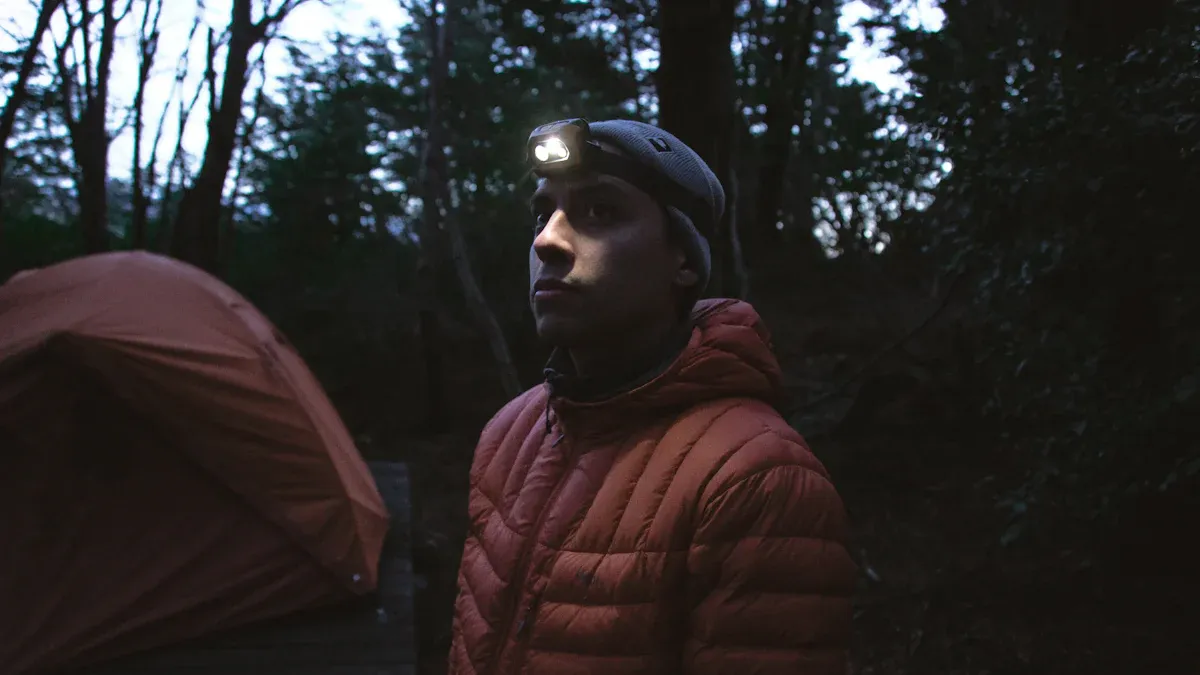
This section provides a detailed examination of some of the most popular and highly-regarded lightweight headlamps available. Each review highlights key features, performance metrics, and what makes each model stand out for outdoor enthusiasts.
Petzl Bindi: Featherlight and Rechargeable
The Petzl Bindi stands out as an exceptionally lightweight and rechargeable headlamp, making it a favorite among minimalists and those who prioritize portability. This headlamp weighs a mere 1.3 ounces (35 grams), offering significant weight savings for any adventure. Despite its diminutive size, the Bindi delivers a maximum output of 200 lumens, providing ample light for various tasks.
Users can select from several lighting modes to conserve battery life or increase visibility. In its highest setting, providing 200 lumens, the Bindi offers approximately 2 hours of illumination. For extended use, the movement mode delivers 100 lumens for about 3 hours. When maximum autonomy is the priority, the proximity mode provides 5 lumens for an impressive 50 hours. Additionally, a red proximity mode offers 3 lumens for 33 hours, preserving night vision and minimizing disturbance to others. The Petzl Bindi’s integrated rechargeable battery simplifies power management, eliminating the need for disposable cells.
Black Diamond Spot 400: Feature-Rich and Durable
The Black Diamond Spot 400 headlamp offers a robust combination of features, durability, and powerful illumination. It provides a maximum output of 400 lumens, casting a spotlight up to 100 meters. This headlamp is rechargeable via micro-USB, offering convenience for users. Its battery life extends significantly, reaching 225 hours on the lowest setting and providing 4 hours of light on its highest output. The Spot 400 maintains a lightweight profile, weighing only 2.6 ounces.
A red light feature is included, which helps preserve night vision. The headlamp boasts an impressive IP67 waterproof rating, meaning it can withstand submersion, ensuring reliability in wet conditions. Its durability receives a high rating of 9.6 out of 10, indicating its robust construction. Beam quality and brightness also score highly at 9.3 out of 10, reflecting its excellent optics and strong performance in both spotlight and wide, evenly lit flood beam modes. The user interface and comfort are rated at 9.0 out of 10, while battery life and charging receive an 8.5 out of 10.
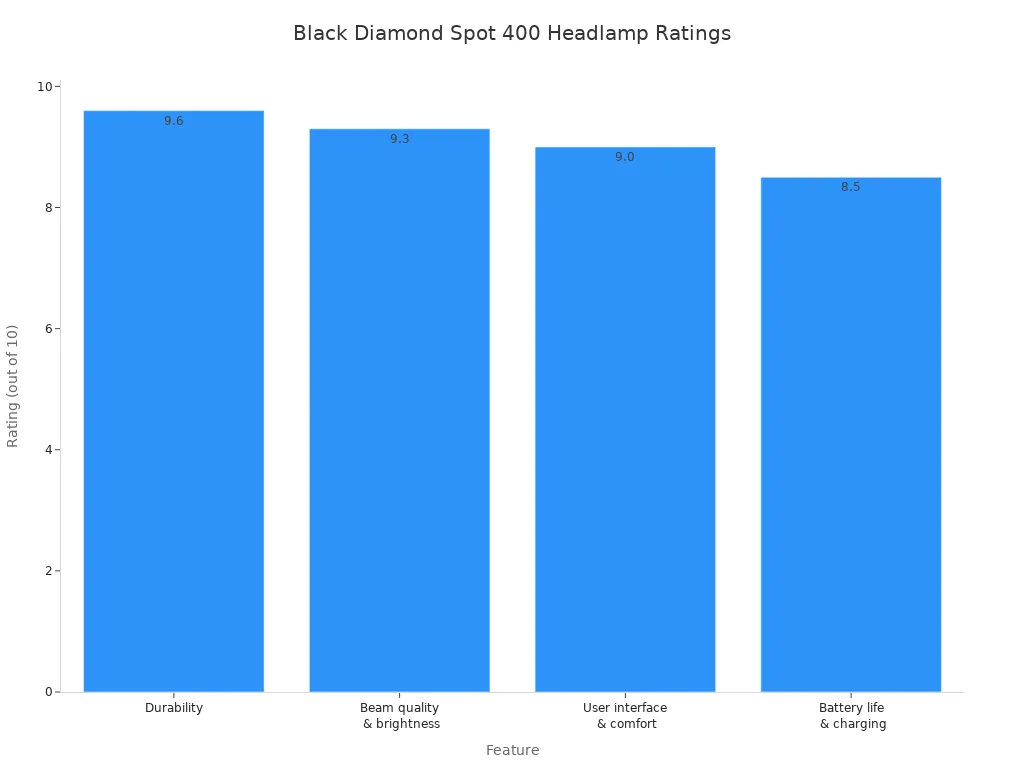
The Black Diamond Spot 400 is recognized for its excellent optics, particularly its strong performance in spotlight mode. It also provides a wide, evenly lit flood beam, making it suitable for camp use. This headlamp has received updates and improvements, especially in its optics, which now offer some of the best beam patterns among tested lights.
Nitecore NU25: The Ultralight Powerhouse
The Nitecore NU25 has earned its reputation as an ultralight powerhouse, particularly appealing to those who demand high performance with minimal weight. This headlamp represents the lightest generation in the NU25 lineup, making it an ideal choice for weight-conscious adventurers. Despite its featherlight design, the NU25 can produce a maximum output of 400 lumens, offering significant illumination for its size.
It features USB-C rechargeable battery technology, providing modern and efficient power management. The Nitecore NU25 also incorporates self-developed MCT UHE LEDs, contributing to its efficiency and performance. This combination of advanced LED technology and efficient battery management positions it as the longest-lasting generation in the NU25 series, implying superior battery efficiency and capacity for extended use.
BioLite HeadLamp 330: Comfort and Innovation
The BioLite HeadLamp 330 distinguishes itself through its innovative design, prioritizing user comfort and efficient illumination. This headlamp weighs only 69 grams, making it exceptionally lightweight for a running headlamp and the lightest in its class. Its balanced weight distribution contributes significantly to comfort. The rechargeable battery module sits at the rear, while a slim 9mm tilting light panel is positioned at the front. This design prevents bounce and eliminates the need for overtightening the strap. Furthermore, a moisture-wicking sweatband keeps sweat off the face, enhancing overall comfort during strenuous activities.
The BioLite HeadLamp 330 offers versatile lighting options. It provides a brightest dual-beam mode with 330 lumens. For extended use, a LO mode delivers 5 lumens, offering up to 40 hours of battery life. The headlamp also includes a 230-lumen white spotlight with a dimmer function. A 110-lumen white floodlight, also featuring a dimmer, provides broad illumination. When users combine the white spotlight and floodlight, the headlamp achieves its 330-lumen maximum output.
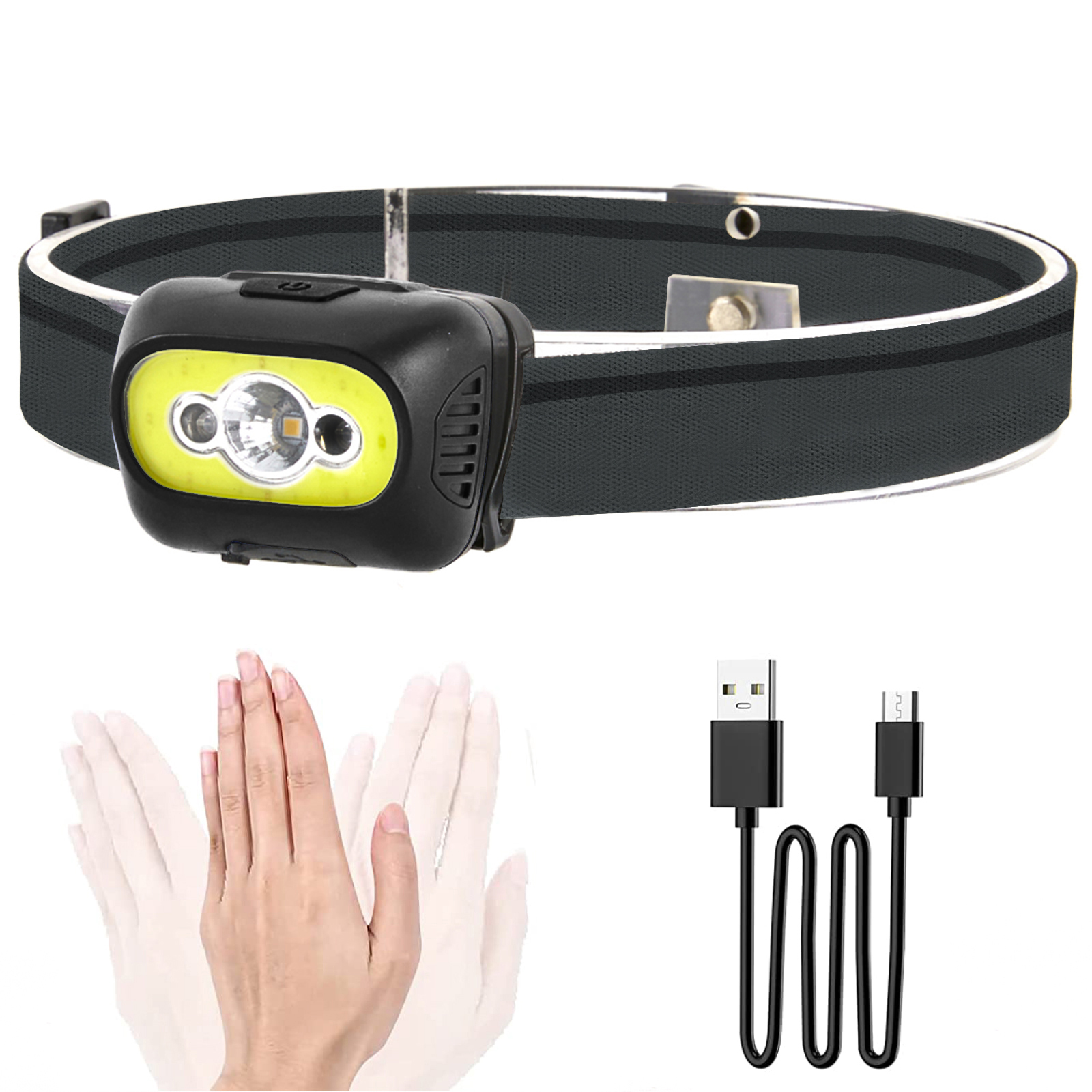
This light is made of ABS material, equipped with COB (white and red) and LED bulbs, delivers 350 lumens output power, comes with one built-in 1200mAh 103040 battery, supports multiple lighting modes including COB&LED full brightness, low COB white light, COB red light and sensor mode activated by long pressing the switch, and features Type-C charging and sensor function.
Fenix HM50R V2.0: Rugged and Versatile
The Fenix HM50R V2.0 headlamp offers a rugged and versatile lighting solution for demanding outdoor environments. It features an impact-resistant housing and solid build quality with durable metal housing. This headlamp is built for extreme conditions, boasting IP68 waterproof and dustproof construction. It remains submersible up to 2 meters for 30 minutes, ensuring reliable performance in all weather. The HM50R V2.0 also performs well in cold conditions.
This headlamp offers significant versatility. It is compact and lightweight, fitting easily into bino harnesses, hip packs, or pockets. A red light mode allows for stealthy movement and preserves night vision. The headlamp provides multi-mode flexibility with four brightness levels and a red light mode. Users can remove it from the headband and use it as a compact handheld flashlight, thanks to its easily removable body and built-in pocket clip. This feature makes it suitable for general household tasks, nighttime walks, night hiking, backpacking, hunting, and fishing. It features white light with various brightness levels, a red light, and a red strobe. The Fenix HM50R V2.0 includes a rechargeable 16340 battery and charges conveniently via USB-C. It also offers compatibility with CR123A batteries for backup power. The headlamp comes standard with a 700mAh rechargeable battery, and additional batteries are available from Fenix.
Coast FL1R: Simple and Effective
The Coast FL1R headlamp provides a simple yet effective lighting solution for various tasks. This headlamp focuses on straightforward functionality and reliable performance.
| Feature | High Setting | Low Setting |
|---|---|---|
| Lumen Output | 435 lumens | 160 lumens |
| Beam Distance | 42 meters | 25 meters |
| Battery Type | 630 mAh lithium polymer (non-removable) | 630 mAh lithium polymer (non-removable) |
On its high setting, the FL1R delivers 435 lumens, illuminating objects up to 42 meters away. For tasks requiring less intensity or to conserve power, the low setting provides 160 lumens with a beam distance of 25 meters. The headlamp utilizes a 630 mAh lithium polymer battery, which is non-removable, ensuring a streamlined design and consistent power source.
How to Choose Your Ideal Compact Outdoor Headlamp

Selecting the perfect headlamp requires careful consideration of several key factors. These elements ensure the chosen device meets specific needs for outdoor activities.
Understanding Brightness and Beam Quality
Brightness, measured in lumens, indicates the total light output of a headlamp. A higher lumen count generally means a brighter light. However, practical beam distance also depends on how the headlamp directs this light. A narrower beam concentrates light, leading to greater visibility further ahead within a smaller field. Conversely, a wider beam spreads light over a larger area, making the overall illuminated space less bright. For activities like ultrarunning, headlamps often feature at least 500 lumens. They also offer multiple beam configurations, including a focused beam for extended distance and a dispersed beam for broader coverage. This versatility allows users to adapt the light to different terrains and situations. Consider the primary use for the headlamp. A broad floodlight works well for camp tasks, while a focused spot beam is better for navigating trails at night.
Battery Types and Runtime Considerations
Headlamps primarily use two types of batteries: disposable or rechargeable. Disposable batteries, typically AA or AAA, offer convenience for long trips where recharging is not feasible. Users can carry spare batteries and replace them as needed. Rechargeable headlamps, often with integrated lithium-ion batteries, provide a cost-effective and environmentally friendly solution. They charge via USB, making them convenient for daily use or trips with access to power banks.
Runtime refers to how long a headlamp operates on a single charge or set of batteries. Manufacturers usually provide runtime specifications for different brightness modes. High lumen settings consume more power, resulting in shorter runtimes. Lower settings extend battery life significantly. Consider the duration of planned activities. For multi-day trips, a headlamp with excellent battery efficiency or the option to carry spare disposable batteries is crucial. Some headlamps offer hybrid systems, allowing both rechargeable and disposable battery use. This provides flexibility and backup power.
Comfort, Fit, and Strap Design
A headlamp’s comfort and fit are paramount, especially during extended use. An ill-fitting headlamp can cause discomfort, headaches, or bounce during movement. Manufacturers design headlamp straps with ergonomic principles to ensure optimal comfort. Many models feature a curved head support, designed to fit the head’s natural curvature. This design distributes pressure evenly.
Strap placement also plays a vital role. The rubber strap is often positioned to minimize plastic contact with the head, with the strap itself providing contact for extended periods. This reduces irritation. Curved length adjusting clips are shaped for good finger grip, allowing for easy and precise adjustments. A lightweight and balanced design contributes to a perfect fit. This minimizes neck strain and fatigue during long hours of wear. Adjustable straps ensure a perfect fit for optimal comfort, accommodating various head sizes and activities. Some headlamps include an over-the-top strap for added stability, particularly beneficial for high-impact activities like trail running.
Water Resistance and IP Ratings
Outdoor activities often expose gear to unpredictable weather. Therefore, a headlamp’s water resistance is a critical factor. The Ingress Protection (IP) rating system, an IEC standard, quantifies a device’s protection against solids and liquids. For headlamps, the “X” in IPX indicates no test for solid particles. The subsequent number denotes the level of water protection.
An IPX4 rating signifies protection against splashing water. This means a headlamp with an IPX4 rating is splash waterproof. It can withstand heavy rain but cannot be submerged in water. An IPX7 rating offers a higher level of protection. It indicates the headlamp can endure immersion up to 1 meter. Understanding these ratings helps users select a headlamp suitable for their expected conditions.
| Level | Protection Against |
|---|---|
| X | Not tested |
| 0 | Not protected |
| 1 | Dripping water |
| 2 | Dripping water tilted at 15° |
| 3 | Spraying water |
| 4 | Splashing of water |
| 5 | Water jets |
| 6 | Powerful water jets |
| 7 | Immersion up to 1 M |
| 8 | Continuous immersion, 1 M or more |
Essential Features: Red Light and Modes
Modern headlamps offer various light modes beyond a simple on/off function. These modes allow users to adapt illumination to specific needs and conserve battery life. A crucial feature for many outdoor enthusiasts is the red light mode. This specialized light offers several distinct advantages.
Red light has minimal impact on the eyes’ ability to adapt to darkness. This makes it ideal for activities like stargazing, wildlife observation, or reading maps without causing temporary blindness. Users can maintain their natural night vision. Red light also reduces light pollution and disruption. It is less intrusive than white light, making it suitable for wildlife observation as it is less likely to startle animals. For tactical or military use, red light helps maintain stealth.
Furthermore, red light is less attractive to most insects. This minimizes disturbances for outdoor enthusiasts during camping or fishing. Red light is also less visible from a distance, offering stealth for camping or security patrols. Hunters use red lights to navigate without spooking game animals, as animals are less sensitive to red wavelengths. In emergencies, a red flashing mode acts as a safety beacon for rescue situations. It also conserves battery life during low-light navigation or power outages. Red light can serve as an emergency signal due to its contrast against dark backgrounds.
Other benefits of red light include:
- Preserving Battery Life: Red light uses less energy than white light, extending the headlamp’s battery life.
- Better Sleep Quality: Red light has a less disruptive effect on circadian rhythm. This can help users fall asleep faster and sleep more soundly, especially when camping or in hostels.
- Improved Nighttime Photography: Red light reduces the likelihood of lens flares and undesired reflections. This makes it easier to get ideal photos at night.
- Faster Focusing: The human eye adjusts more quickly to red light than to white light during the transition from darkness to light. It does not cause the pupil to constrict as much.
Weight and Portability Factors
The weight of a headlamp significantly impacts user experience, especially during extended outdoor activities. Lighter headlamps are generally more comfortable for prolonged wear. Users often forget they are wearing ultralight models. These lighter options are also less prone to shifting or bouncing during dynamic activities like running or climbing.
Conversely, heavier headlamps, while potentially offering more features or brightness, can negatively affect comfort. This is particularly true during fast movements or long durations. Some designs aim to mitigate the impact of weight. They integrate wires into the headband and use a wide, shallow design to keep the battery pack close to the head. This prevents jostling.
Here is a comparison of weights for various headlamp models:
| Headlamp Model | Weight (oz) |
|---|---|
| BioLite Headlamp 325 | 1.76 |
| Black Diamond Wiz | 2 |
| Simond Forclaz HL900 | 3.7 |
| Silva Trail Runner Free H | 3.8 |
| Coast RL35R | 7.1 |
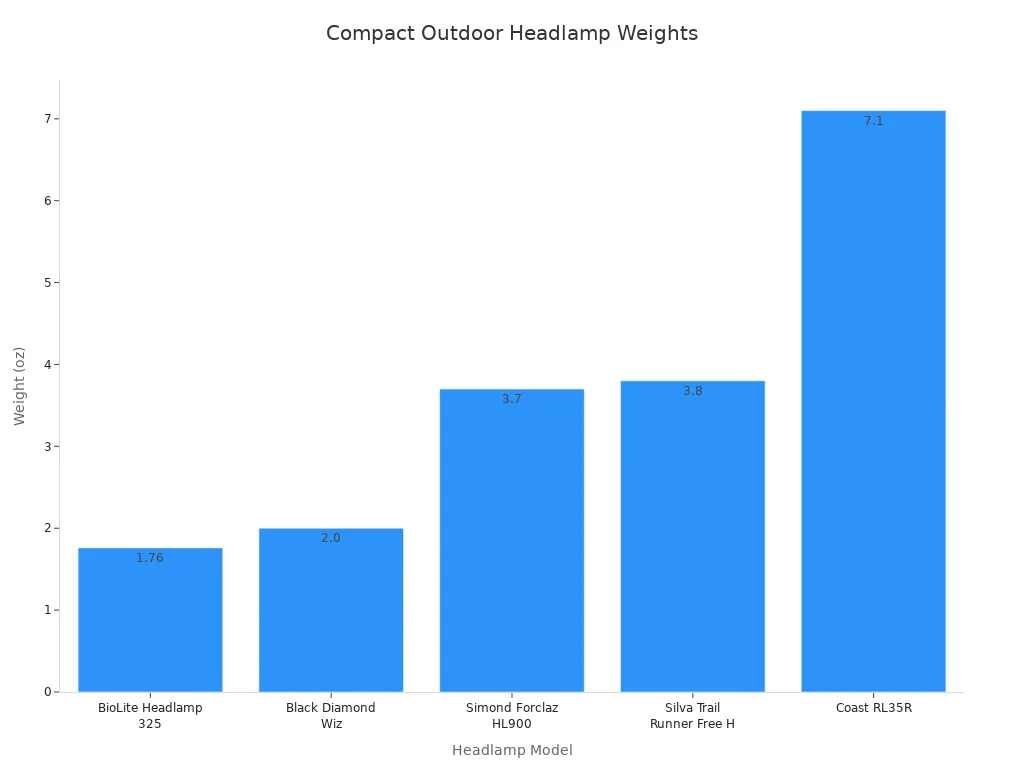
The BioLite Headlamp 325, weighing 1.76 ounces, exemplifies an ultralight and ultra-packable design. This makes it highly comfortable for extended wear. The Coast RL35R, at 7.1 ounces, represents a heavier option. Its weight implies a trade-off in comfort for potential added features or brightness. Backpackers and trail runners often prioritize minimal weight to reduce fatigue and enhance performance.
Rechargeable vs. Disposable: Powering Your Compact Outdoor Headlamps
Choosing the power source for a headlamp involves weighing convenience, cost, and environmental impact. Outdoor enthusiasts often debate between rechargeable and disposable battery options. Each type offers distinct advantages for various adventures.
Advantages of Rechargeable Headlamps
Rechargeable headlamps offer significant long-term cost savings. They eliminate the need for continuous purchases of disposable batteries. Environmentally, these headlamps reduce waste, as disposable batteries often end up in landfills. They contain fewer toxic materials, minimizing soil and water pollution. Recharging these headlamps requires less energy than producing new batteries, leading to lower carbon emissions. While they might have a higher upfront cost, rechargeable headlamps save money over time by eliminating recurring battery purchases. Additionally, they are more convenient due to quick USB recharging, often compatible with power banks.
Benefits of Disposable Battery Headlamps
Disposable battery headlamps offer immediate availability. Their batteries are readily available in most stores. This allows for quick replacement and continuous use. If a headlamp runs out of power, new batteries can be inserted instantly. This provides immediate functionality without needing a power source or waiting for a charge, unlike rechargeable models. For cold-weather performance, disposable headlamps using lithium batteries perform excellently in extreme temperatures, both hot and cold. These batteries are also lighter and store more energy than alkaline options, making them a superior choice for challenging conditions.
Hybrid Options and Considerations
Some Compact Outdoor Headlamps offer hybrid power solutions. These models can use both rechargeable battery packs and standard disposable batteries. This flexibility provides the best of both worlds. Users can rely on the rechargeable option for daily use and carry disposable batteries as a backup for extended trips or emergencies. This ensures continuous illumination regardless of access to charging points.
Key Specifications for Compact Outdoor Headlamps
Understanding key specifications helps outdoor enthusiasts select the most suitable headlamp for their adventures. These technical details provide crucial insights into a headlamp’s performance and utility.
Lumens and Beam Distance Explained
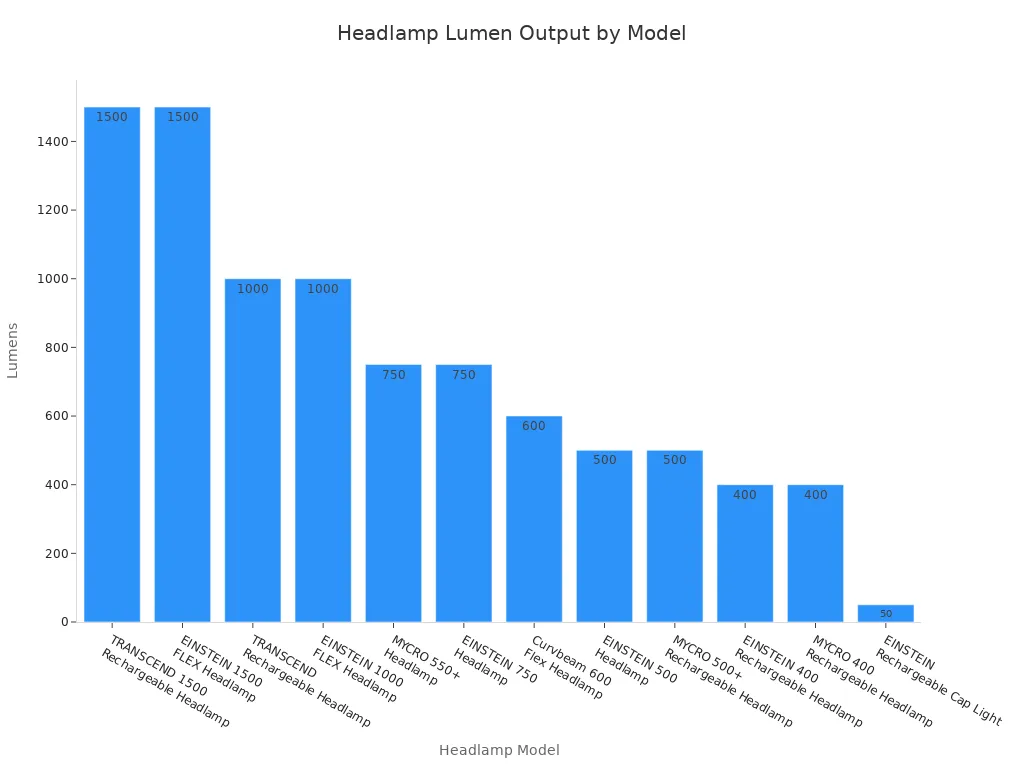
Lumens quantify the total light output a headlamp produces. A higher lumen count indicates a brighter light. Beam distance, conversely, measures how far the light projects effectively. This distance depends on the beam’s focus. A narrow beam concentrates light, extending visibility further ahead. A wider beam spreads light over a larger area, illuminating a broader field. NEBO LED headlamps, for example, offer a range of brightness levels. Specific series like Transcend and Einstein provide outputs up to 1,500 lumens. These models are small and lightweight, making them easy to pack for multi-day climbs or hikes.
| Headlamp Model | Lumens |
|---|---|
| MYCRO 550+ Headlamp | 750 |
| TRANSCEND Rechargeable Headlamp | 1000 |
| EINSTEIN 500 Headlamp | 500 |
| EINSTEIN 400 Rechargeable Headlamp | 400 |
| MYCRO 400 Rechargeable Headlamp | 400 |
| EINSTEIN Rechargeable Cap Light | 50 |
| Curvbeam 600 Flex Headlamp | 600 |
| MYCRO 500+ Rechargeable Headlamp | 500 |
| TRANSCEND 1500 Rechargeable Headlamp | 1500 |
| EINSTEIN 1500 FLEX Headlamp | 1500 |
| EINSTEIN 1000 FLEX Headlamp | 1000 |
| EINSTEIN 750 Headlamp | 750 |
Battery Life and Burn Time
Headlamp battery life, also known as burn time, indicates how long a headlamp operates on a single charge or set of batteries. The ANSI/PLATO FL 1 Standard, established in 2009 and revised in 2016, defines burn time. Measurement begins 30 seconds after activation with new batteries. It concludes when brightness drops to 10% of its initial level. Petzl, for instance, adheres to this standard. They also communicate the length of time a headlamp operates in ‘reserve mode’ (at 10% brightness or below). Several factors influence burn time:
- Power Mode: The chosen power mode, such as high-power versus power-saving, affects burn time. Regulated output also plays a role.
- Battery Status and Quality: The charge level and quality of the battery are influential.
- Environmental Conditions: Cold temperatures significantly impact battery performance. This reduces maximum burn time.
- Battery Type and Size: The size and type of battery significantly impact operation duration and brightness level. Larger batteries generally offer longer burn times. However, they can add weight and bulk.
- Brightness Settings: Most headlamps have multiple brightness settings. Each setting has a corresponding burn time. Higher brightness settings result in shorter burn times. Lower settings extend battery life. Some brands highlight impressive ‘max burn time’ numbers. These correspond to the lowest brightness setting, not the maximum brightness.
- Programming: Headlamps can be programmed for specific performance. Some prioritize high initial brightness that gradually dims. This extends burn time. Others maintain consistent brightness by consuming more battery power. Advanced technology can automatically adjust brightness to conserve battery life.
Weight in Ounces and Grams
The weight of a headlamp directly impacts user comfort and portability. Lighter headlamps are more comfortable for prolonged wear. Users often forget they are wearing ultralight models. These lighter options are less prone to shifting or bouncing during dynamic activities. Compact Outdoor Headlamps prioritize minimal weight. This reduces fatigue and enhances performance during activities like backpacking or trail running.
IPX Rating for Water Resistance
A headlamp’s water resistance is crucial for outdoor activities. The Ingress Protection (IP) rating system, an IEC standard, quantifies a device’s protection against solids and liquids. For headlamps, the “X” in IPX indicates no test for solid particles. The subsequent number denotes the level of water protection. An IPX4 rating signifies protection against splashing water. This means a headlamp with an IPX4 rating withstands heavy rain. However, users cannot submerge it in water. An IPX7 rating offers a higher level of protection. It indicates the headlamp endures immersion up to 1 meter for a specific duration. Understanding these ratings helps users select a headlamp suitable for their expected conditions. Choosing the correct IPX rating ensures the headlamp functions reliably in various weather.
Special Features Overview
Modern headlamps offer various specialized features beyond basic illumination. These enhancements improve usability and performance in diverse outdoor scenarios.
- Lockout Mode: This feature prevents accidental activation. It ensures the headlamp does not turn on inside a bag, conserving battery life.
- Flood Mode: This setting creates a broad, close light. It illuminates a wide area for tasks like setting up camp or cooking.
- Spot Mode: This mode provides focused light. It allows users to see objects at a distance, useful for navigating trails or identifying landmarks.
- Red Night Vision Mode: This specialized lighting preserves night vision. It helps users see in the dark without disrupting their eyes’ natural adaptation. It also minimizes disturbance to others in a group or to wildlife.
These features enhance a headlamp’s versatility. They allow users to adapt their light source to specific needs during any adventure.
Selecting the ideal Compact Outdoor Headlamps involves evaluating brightness, beam quality, battery type and runtime, comfort, water resistance, and essential features like red light. For overall performance, the Black Diamond Spot 400-R stands out. Trail runners often prefer the BioLite Dash 450 Rechargeable, while minimalists favor the Nitecore NU25 UL. A reliable, lightweight headlamp significantly enhances safety and enjoyment during any outdoor adventure.
FAQ
What do lumens and beam distance signify?
Lumens measure a headlamp’s total light output. A higher lumen count indicates brighter light. Beam distance shows how far the light projects effectively. This distance depends on the beam’s focus. A narrow beam extends visibility further ahead. A wider beam illuminates a broader area.
Why is a red light mode beneficial?
Red light mode preserves night vision. It helps users see in the dark without disrupting their eyes’ natural adaptation. It also minimizes disturbance to others or to wildlife. Red light uses less energy, extending battery life. It is also less attractive to most insects.
What does an IPX rating indicate for headlamps?
An IPX rating quantifies a headlamp’s protection against water. The number after “IPX” denotes the level of water resistance. For example, IPX4 means splash-proof, suitable for heavy rain. IPX7 indicates immersion up to 1 meter. This rating ensures reliability in various weather conditions.
How does headlamp weight affect comfort?
A headlamp’s weight significantly impacts user comfort. Lighter headlamps are more comfortable for prolonged wear. They are less prone to shifting or bouncing during dynamic activities. Heavier headlamps can cause discomfort or fatigue, especially during long hours of use. Minimal weight enhances performance.
Post time: Jul-09-2026


