 fannie@nbtorch.com
 +0086-0574-28909873



A headlamp’s operational duration depends significantly on its battery type, capacity, and selected output mode. Headlamps featuring larger mAh rechargeable batteries or multiple AA/AAA batteries deliver the longest runtimes. Users achieve maximum duration when they select lower brightness settings. For optimal endurance, individuals should seek models designed for extended use. These often incorporate efficient LEDs and robust power management systems. A proper runtime comparison helps identify the most suitable options for specific needs.
Key Takeaways
- A headlamp‘s battery life depends on its battery type, size, and how bright you set it.
- The ANSI FL1 standard helps you compare headlamps fairly by measuring how long they give useful light.
- Using a lower brightness setting makes your headlamp battery last much longer.
- Cold weather makes batteries run out faster, so choose the right battery for cold conditions.
- You can make your headlamp last longer by carrying extra batteries or using its red light mode.
Understanding Headlamp Runtime Comparison Ratings
What ‘Runtime’ Really Means: ANSI FL1 Standard Explained
Understanding headlamp runtime requires familiarity with the ANSI FL1 standard. This standard provides a consistent method for measuring light output and duration, allowing for a fair runtime comparison between different models. According to ANSI FL1, runtime measures the time it takes for the light output to drop to 10% of its initial brightness. Manufacturers conduct testing by turning on the headlamp with fresh batteries and timing until its brightness reaches this 10% mark. The initial light output value is typically measured 30 seconds after the headlamp is turned on. It is important to note that runtime varies significantly between different output modes, such as eco versus turbo settings.
Why Manufacturers’ Claims Vary: Testing Conditions and Brightness Levels
Manufacturers’ runtime claims often vary due to differing testing conditions and brightness levels. Without a universal standard, some companies might test their headlamps at extremely low lumen outputs to achieve impressive, but less practical, runtime figures. Others might use different battery types or environmental conditions during their tests. These inconsistencies make a direct runtime comparison challenging for consumers. The brightness level selected for testing directly impacts the reported duration; a headlamp operating at its maximum lumen output will naturally have a much shorter runtime than one set to its lowest, most efficient mode.
The Difference Between ‘Usable Light’ and ‘Total Runtime’
Consumers often confuse ‘usable light’ with ‘total runtime,’ but these terms represent distinct concepts. ‘Total runtime’ refers to the entire period a headlamp emits any light, even if it is barely visible. ‘Usable light,’ however, refers to the duration a headlamp provides sufficient illumination for a given task. The ANSI FL1 standard addresses this by defining runtime until the output drops to 10% of initial brightness, which generally represents the end of “usable light” for most practical purposes. For example, a 350-lumen headlamp, measured by an older standard that considered light usable at 2 meters, might claim a 40-hour runtime. Under the current ANSI FL1 standard, the same headlamp might only show a 2-hour runtime. This significant 38-hour difference highlights how much longer a headlamp can continue to emit some light, even after it is no longer considered “usable” by modern standards.
Key Factors Influencing Headlamp Battery Life
Battery Type and Capacity: Rechargeable vs. Disposable
The type and capacity of a headlamp’s battery significantly determine its operational life. Rechargeable lithium-ion batteries, often measured in milliampere-hours (mAh), offer convenience and a high energy density. Larger mAh ratings generally translate to longer runtimes. Disposable batteries, such as AA or AAA cells, provide a reliable power source, especially in remote areas where recharging is not an option. Headlamps designed to use multiple disposable batteries often achieve extended durations. Users must consider their typical usage patterns when choosing between these battery types.
Brightness Settings (Lumens): Direct Impact on Duration
Brightness settings, measured in lumens, directly impact a headlamp’s duration. Operating a headlamp at its maximum lumen output drastically reduces battery life. For instance, no current flashlight using an 18650 battery can sustain 500 lumens for four hours, indicating a significant power draw at higher brightness levels. Runtimes are often misleading; a headlamp boasting a long runtime at 100 lumens may not achieve those runtimes in practice, suggesting that higher brightness settings would deplete the battery even faster. Manufacturers frequently report ‘max burn time’ for the lowest brightness setting, not the maximum brightness. This can mislead consumers into believing a 500-lumen headlamp will last for extended periods on its highest setting, when in reality, the max brightness ties to the shortest burn time.
LED Efficiency and Power Management Systems
Modern headlamps incorporate efficient LEDs and sophisticated power management systems to optimize battery life. Advanced dimmable LEDs consume less power, generate less heat, and provide more light per unit of energy. This allows batteries to last for entire shifts. Dimming features also extend the burn time and battery life by allowing users to adjust the headlamp’s brightness to suit the task or environment. Intelligent power regulation systems maintain consistent brightness throughout the battery’s discharge cycle, preventing gradual dimming as power decreases. Some headlamps also feature dual-fuel technology, allowing them to use either a rechargeable lithium-ion battery or disposable AAA alkaline batteries, providing flexibility and ensuring continuous power.
Environmental Factors: Temperature’s Role in Battery Performance
Environmental factors, particularly temperature, significantly influence a headlamp’s battery performance. Cold temperatures reduce battery efficiency and capacity, directly impacting runtime. Batteries deliver less power in freezing conditions compared to room temperature. This reduction varies depending on the battery chemistry.
| Battery Chemistry | 20°C (68°F) | 0°C (32°F) |
|---|---|---|
| Alkaline (AA/AAA) | 100% | 68% |
| NiMH (Rechargeable AA) | 100% | 75% |
| Lithium-Ion (18650) | 100% | 85% |
| Lithium Primary (CR123A) | 100% | 92% |
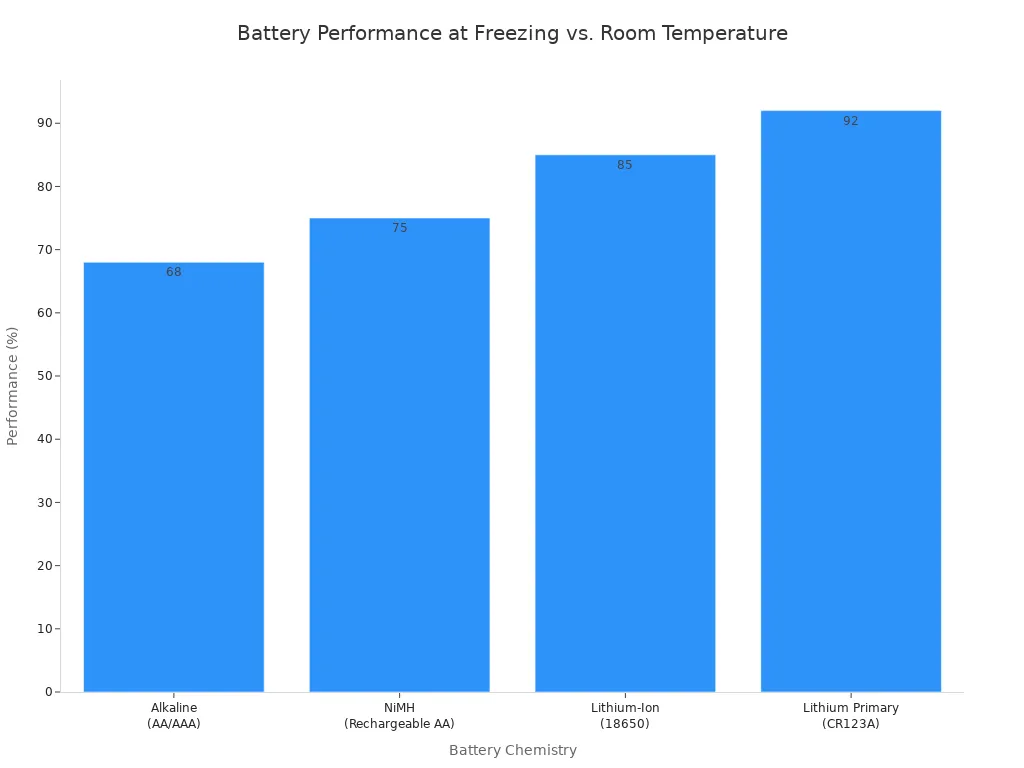
As the chart illustrates, lithium primary CR123A batteries maintain the highest percentage of their capacity in cold conditions. Lithium-ion (18650) batteries also perform well, retaining 85% of their capacity at 0°C. Alkaline and NiMH batteries experience more significant performance drops.
Cold temperatures cause voltage sag in batteries. This phenomenon triggers a headlamp’s ‘eco mode’ or lower brightness settings prematurely. For example, a trail runner observed a 1000-lumen headlamp, powered by dual 18650 Li-ion batteries, fade to 300 lumens within eight minutes. This occurred at temperatures between -5°C and 2°C. The cold-induced voltage sag, not a battery defect, caused this dimming. Switching to lithium primary CR123A batteries extended the high-mode runtime from eight to 32 minutes at -3°C. Users can also pre-warm the lamp inside a jacket for five minutes. This action raises the battery surface temperature by approximately 7°C, delaying dimming by over 15 minutes. Proper battery selection and management are crucial for optimal performance in cold environments.
Top Headlamps for Extended Runtime Comparison

Selecting the ideal headlamp involves more than just lumen output; runtime capabilities are crucial for various activities. This section explores top headlamp models, categorizing them by their suitability for different duration needs. A thorough runtime comparison helps users make informed decisions.
Best for Ultra-Long Expeditions (Lowest Brightness, Max Duration)
For adventurers embarking on multi-day treks or ultra-long expeditions, headlamps offering exceptional duration at their lowest brightness settings become indispensable. These models prioritize longevity, ensuring light remains available for critical tasks like navigation or camp setup, even after many hours of use.
| Model | Lowest Brightness (Lumens) | Max Duration (Hours) |
|---|---|---|
| Fenix HP25R V2.0 | Not specified | 400 |
| BioLite Headlamp 750 | 5 (reserve mode) | 150 (LO) / 8+ (reserve mode) |
| Petzl IKO CORE | 6 | 100 |
The Fenix HP25R V2.0 stands out with an impressive 400-hour maximum duration, making it a strong contender for extended journeys. While its lowest brightness lumen count is not explicitly stated, its design focuses on ultra-long runtime capabilities. The BioLite Headlamp 750 provides 150 hours on its low setting and offers over 8 hours in a 5-lumen reserve mode, a practical feature for emergencies. Similarly, the Petzl IKO CORE delivers 100 hours of light at a minimal 6 lumens, proving its endurance for prolonged use in the wilderness. These headlamps ensure users retain illumination for critical tasks throughout their adventures.
Best for Balanced Runtime and Usable Brightness (Medium Settings)
Many outdoor enthusiasts seek a balance between sufficient light output and respectable battery life for general activities like camping, hiking, or evening chores. These headlamps offer versatile performance, providing usable brightness without requiring constant battery changes.
| Model | Max Brightness (Lumens) | Max Burn Time (Lowest Setting) | Key Features / Balance |
|---|---|---|---|
| Petzl Tikkina | N/A | 100 hours | Budget-friendly, sufficient for casual use |
| Black Diamond Distance LT1100 | 1100 | 120 hours | High power with excellent battery life across settings |
| Nitecore NU25 UL | N/A | 61-110 hours | Ultralight, affordable, extended battery life |
| Petzl Actik / Actik CORE | N/A | 130 hours | Hybrid energy (AA/rechargeable CORE), flexible and long-lasting |
| Black Diamond Spot 400-R | 400 | 200 hours | Exceptional burn time, ideal for multi-day trips, instant brightness adjustment |
The Black Diamond Spot 400-R offers an excellent balance for camping and general outdoor use. It weighs only 2.6 ounces, making it comfortable for extended wear. This headlamp provides a maximum output of 400 lumens, which is ample for non-technical adventures. Its PowerTap technology allows for instant brightness adjustment, enhancing user convenience. The Spot 400-R boasts impressive burn times, ensuring extended use for hiking, cooking, and setting up camp. It effectively balances comfort, durability, and functionality for outdoor enthusiasts.
The Petzl Actik Core also exemplifies this balance. Its medium setting, typically around 100 lumens, offers practical runtimes. Reviews indicate the new version of the Petzl Actik Core provides 12 hours of burn time at 100 lumens, a significant improvement over the older model’s 7 hours. Other reports suggest the Actik Core can last an entire night of continuous use, estimated at 8 hours, when starting with a full charge on its ‘normal’ medium mode. The Actik Core’s flexibility with hybrid energy, allowing both its CORE rechargeable battery and 3 AAA batteries, further enhances its appeal for balanced performance. With the CORE rechargeable battery, it achieves 7 hours at 100 lumens, while 3 AAA batteries extend this to 10 hours at the same brightness.
Best for High Output with Decent Runtime (Compromises)
Some situations demand high lumen output, even if it means a shorter overall runtime. These headlamps prioritize intense illumination for tasks requiring maximum visibility, such as fast-paced trail running, technical climbing, or search and rescue operations. Users accept a compromise on duration for superior brightness. While specific models are not detailed here, headlamps in this category typically feature larger battery packs or more advanced cooling systems to manage the heat generated by powerful LEDs. They often include multiple brightness modes, allowing users to drop to lower settings to conserve power when maximum output is not essential. This approach provides flexibility, offering high power when needed and extending battery life during less demanding periods.
Headlamps with Swappable/External Battery Packs for Infinite Runtime
For users requiring virtually unlimited illumination, headlamps featuring swappable or external battery packs offer a superior solution. These designs overcome the inherent limitations of fixed internal batteries, providing continuous light for extended expeditions, multi-day adventures, or professional tasks. The ability to quickly exchange a depleted battery for a fresh one, or connect to an external power source, ensures uninterrupted operation.
Many modern headlamps are rechargeable. However, some models allow users to swap a removable power pack for disposable batteries, such as triple-A cells. This feature proves particularly useful for extended trips where recharging facilities are unavailable. Headlamps designed for sub-freezing temperatures often include an extendable battery pack. Users can store this pack in a coat pocket, preventing premature battery drain caused by cold.
Several headlamp models specifically cater to this need for extended power:
| Model | Battery/Power Options |
|---|---|
| HA11 | Compatible with AA/14500 batteries |
| HC70 UHE | Powered by a replaceable 6000mAh Li-ion battery |
| HU2000 | Split-type work headlamp with a USB-C extension cable, compatible with most power banks |
| HA15 UHE | Compatible with various AA batteries and the NL1411R 14500 Li-ion battery |
| HA23 UHE | Offers dual power options for long-lasting runtime |
| HC75 UHE | Includes a replaceable 5,500mAh high-capacity Li-ion battery |
These models demonstrate a commitment to maximizing operational duration through flexible power solutions. For instance, the Nitecore HA11 and HA15 UHE offer compatibility with both standard AA batteries and rechargeable 14500 Li-ion cells. This dual-fuel capability provides versatility. Similarly, the HC70 UHE and HC75 UHE feature high-capacity replaceable Li-ion batteries, allowing users to carry spares for quick swaps. The HU2000, a split-type work headlamp, takes this concept further. It connects to most power banks via a USB-C extension cable, effectively turning any compatible power bank into an external battery for the headlamp.
Beyond integrated solutions, accessories also enhance runtime. Nitecore, for example, offers an ‘Extended Headlamp Runtime Kit’ as an accessory. This kit provides additional power capacity for compatible headlamps. Many headlamps use rechargeable battery packs or AA/AAA batteries. Some, like the Nitecore UT27 MCT Pro and Fenix HL18R-T V2.0, can operate on both their included rechargeable battery or AAA batteries. This flexibility is beneficial when outlets or power banks are unavailable. Carrying spare AA/AAA batteries can be easier and lighter than a power bank for some users. Petzl lights, including the Petzl Iko Core, often utilize proprietary rechargeable batteries. The Petzl Nao RL uses larger batteries to provide extended lighting, suitable for a full night of use.
Connecting an external power bank significantly extends a headlamp’s operational duration. Using an external power bank like the Nitecore Carbon Battery 6K Kit can significantly extend the runtime of compatible Nitecore headlamps, such as the NU40, NU43, NU45, NU50, NU53, and HC60. This kit is capable of doubling or even tripling the headlamp’s operational duration.
This is a nice quality item and increased run time as advertised.
This feedback highlights the practical benefits of such external power solutions. They provide a reliable way to maintain illumination for extended periods, making a significant difference in a headlamp runtime comparison. Users gain peace of mind knowing they possess ample power for any situation.
How to Maximize Your Headlamp’s Runtime

Users can significantly extend a headlamp‘s operational duration through strategic choices and proper maintenance. Understanding how to manage power consumption ensures light remains available when needed most. These practices help users get the most out of their headlamp’s battery life.
Choosing the Right Brightness Mode for the Task
Selecting the appropriate brightness mode directly impacts a headlamp’s runtime. Operating a headlamp at its highest setting consumes battery power rapidly. For example, a headlamp might offer only 2 hours of battery life on its highest brightness setting. Conversely, using the lowest brightness setting can extend the battery life dramatically, often providing up to 100 hours of illumination. This significant difference highlights the importance of matching light output to the specific task. The lowest setting still provides sufficient light for close-range activities, even if it reduces the beam distance to 10 meters or less. Users should always choose the lowest effective lumen output for their current activity.
Carrying Spare Batteries or Power Banks
Preparedness is key for extended headlamp use. Carrying spare batteries or a portable power bank ensures continuous illumination during long expeditions or multi-day trips. For headlamps using disposable cells, users can pack extra AA or AAA batteries. For rechargeable models, a fully charged spare battery pack or a compatible power bank provides a convenient backup. Many modern headlamps feature USB-C charging, allowing users to connect them directly to a power bank for on-the-go recharging. This strategy eliminates concerns about running out of light in critical situations.
Proper Battery Care and Storage
Correct battery care and storage practices preserve battery health and maximize runtime. Users should avoid extreme temperatures when storing headlamp batteries.
As you probably know, you should really keep these cells as close to room temperature as you can, and hope that in the future we get a better technology for batteries we use as much as this kind.
The ideal storage temperature for most batteries, including lithium-ion, is 59°F (15°C). Storing batteries in a cool, dry place away from direct sunlight helps maintain their capacity and extends their overall lifespan. Users should also avoid fully discharging lithium-ion batteries regularly, as this can degrade their performance over time.
Utilizing Red Light Modes for Minimal Power Consumption
Headlamps often include a red light mode. This feature offers significant advantages for power conservation and specific tasks. Red light consumes considerably less energy than white light. This extends a headlamp’s operational duration. Users can preserve battery life by switching to red light when maximum illumination is unnecessary.
Red light also helps maintain night vision. Human eyes adapt to darkness more quickly after exposure to red light compared to white light. This makes red light ideal for activities like stargazing, reading maps in low light, or moving around a campsite without disturbing others. It provides enough visibility for close-range tasks without causing pupils to constrict as much as white light. This allows eyes to remain accustomed to the dark surroundings.
The power efficiency of red light modes is substantial. For instance, the HL500 headlamp demonstrates this difference clearly. It offers a runtime of up to 32 hours when operating on its lowest white light setting. However, when users switch to the red light mode, the headlamp can last up to 49 hours. This means the red light mode provides an additional 17 hours of illumination compared to the lowest white light setting. This extended duration is crucial for multi-day trips or emergency situations where power sources are limited.
Therefore, users should consider employing the red light mode whenever possible. It provides sufficient light for many common tasks while drastically reducing power consumption. This strategic use of red light significantly contributes to maximizing a headlamp’s overall runtime. It ensures light remains available for longer periods.
The longest-lasting headlamp results from smart choices. Users select appropriate battery capacity, understand runtime ratings, and actively manage brightness settings. This comprehensive approach ensures optimal performance. For ultimate longevity, prioritize models with large capacity batteries or external power options. Always operate at the lowest effective lumen output. This ensures light when needed most, making a significant difference in any runtime comparison.
FAQ
What does the ANSI FL1 standard mean for headlamp runtime?
The ANSI FL1 standard provides a consistent way to measure headlamp performance. It defines runtime as the period until the light output drops to 10% of its initial brightness. This standard helps consumers make fair comparisons between different headlamp models.
Why do headlamps have different runtimes at various brightness levels?
Higher brightness settings, measured in lumens, demand more power from the battery. This increased power consumption depletes the battery faster. Consequently, a headlamp operating at its maximum brightness will have a much shorter runtime than one used on a lower, more efficient setting.
How does cold weather impact a headlamp’s battery life?
Cold temperatures significantly reduce battery efficiency and capacity. Batteries deliver less power and drain more quickly in freezing conditions. Lithium primary batteries generally maintain better performance in the cold compared to alkaline or NiMH batteries.
Can users swap disposable batteries into a rechargeable headlamp?
Some rechargeable headlamps feature dual-fuel technology. They can operate on their included rechargeable battery or standard disposable AA/AAA batteries. This versatility offers a practical backup power source, especially during extended trips without access to charging.
What is the difference between ‘usable light’ and ‘total runtime’?
‘Usable light’ refers to the duration a headlamp provides sufficient illumination for a task. ‘Total runtime’ includes the entire period a headlamp emits any light, even if it is barely visible. The ANSI FL1 standard focuses on ‘usable light’ by measuring until 10% of initial brightness.
Post time: Jun-25-2026


