 fannie@nbtorch.com
 +0086-0574-28909873



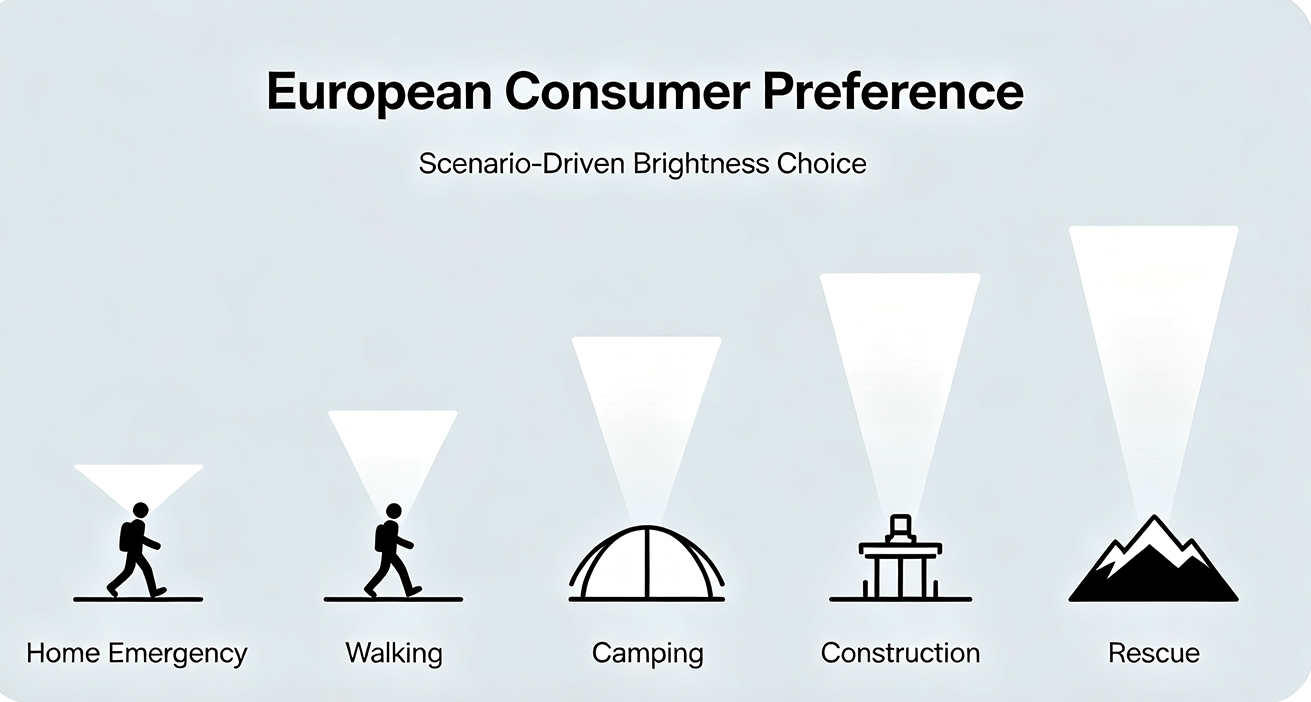
The European portable headlamp market continues its steady growth, with a projected increase from USD 1.0 billion in 2025 to USD 1.6 billion by 2033, driven by booming outdoor recreation, strict industrial safety standards, and rising demand for portable emergency lighting . For headlamp manufacturers, exporters, and Amazon/e-commerce sellers targeting the EU market, one question always stands out: Which is more popular in Europe, high lumen headlamps or low lumen headlamps?
Many overseas suppliers assume higher lumens equal better sales and higher profits, so they blindly upgrade headlamp brightness and pursue ultra-high lumen parameters. However, European market feedback and 2026 updated EU lighting regulations prove this strategy is not always correct. Low lumen headlamps occupy a stable and large market share in European civilian consumption, while high lumen models dominate professional and industrial scenarios. The real EU market preference depends on usage scenarios, regulatory compliance thresholds, battery efficiency, and local consumer habits.
In this in-depth SEO guide, we will compare high lumen and low lumen headlamps in terms of European consumer preference, regulatory adaptability, battery performance, pricing competitiveness, and sales volume trends, helping you accurately position products and capture the mainstream demand of the 2026 EU headlamp market.
1. Clear Definition: High Lumen vs Low Lumen Headlamps (EU Market Standard)
Before analyzing market popularity, it is necessary to clarify the lumen classification standards recognized by European consumers and industry institutions, avoiding parameter confusion caused by different regional definitions. Combined with EU outdoor lighting industry reports and mainstream brand product classification rules in 2026, the portable headlamp lumen hierarchy is clearly divided as follows.
Low Lumen Headlamps (10LM – 300LM): The mainstream civilian daily-use models in the European market. Typical products range from 50LM to 200LM, with soft and uniform light output, no strong glare, and ultra-low power consumption. They are mainly positioned for daily household emergency, night walking, camping auxiliary lighting, and child safety lighting, focusing on lightweight portability and long battery life.
High Lumen Headlamps (800LM – 3000LM+): Professional-grade outdoor and industrial lighting equipment. Most mainstream professional models in Europe are between 1000LM and 2000LM, with ultra-high brightness, long-range beam projection, and strong floodlighting capability. They are suitable for wild exploration, night mountain climbing, construction work, mining operations, and emergency rescue scenarios, prioritizing extreme lighting performance and environmental adaptability.
Medium Lumen (300LM – 800LM): A transitional model with balanced performance, but it has no obvious competitive advantage in the European market. It is neither energy-saving enough for daily use nor professional enough for high-intensity scenarios, resulting in low market share and poor user stickiness.
European consumers have formed a fixed consumption cognition: low lumen for daily leisure, high lumen for professional work. This scenario-based demand segmentation is the core logic of the EU headlamp market differentiation.
2. 2026 EU Regulatory Adaptability: Low Lumen Models Have Natural Compliance Advantages
The updated 2026 EU lighting product regulations have become a key factor affecting product marketability, and there are obvious compliance differences between high and low lumen headlamps. Many manufacturers ignore regulatory threshold differences, leading to high lumen products failing photobiological safety tests and being detained by EU customs.
First, in terms ofphotobiological safety (EN 62471-2:2026), the EU enforces mandatory RG1 risk group certification for all portable LED headlamps in 2026. Low lumen headlamps with below 300LM output produce extremely low blue light and ultraviolet radiation, which can easily pass RG1 safety tests without additional optical debugging. In contrast, high lumen headlamps with over 1000LM brightness are prone to blue light overflow and retinal radiation risks. Manufacturers need to invest heavily in optical lens optimization, light homogenization design, and radiation reduction treatment to meet EU safety standards, greatly increasing production and testing costs.
Second, in terms of glare control and public safety regulations, European countries such as Germany, France, and the UK have strict restrictions on outdoor strong light equipment. Ultra-high lumen headlamps with unoptimized light spots are likely to produce strong stray light, which violates EU anti-glare regulations and may even be deemed as potential public safety hazards. Low lumen headlamps with soft light output fully comply with daily outdoor activity norms and have no usage restrictions in public camping, hiking, and residential scenarios.
Third, combined with EU energy efficiency and environmental protection requirements, low lumen headlamps have lower power consumption, longer standby time, and less battery waste, which are more in line with the EU’s circular economy and energy-saving advocacy. They are easier to pass RoHS, REACH, and energy efficiency audits, with simpler certification processes and lower compliance thresholds.
In summary, from the perspective of regulatory pass rate and compliance cost, low lumen headlamps are more friendly to the EU mass market, while high lumen products are only suitable for professional segmented markets with higher tolerance for compliance costs.
3. Consumer Preference Analysis: Low Lumen Dominates Civilian Market, High Lumen Leads Professional Scenarios
European consumer demand for headlamps is highly segmented, and the popularity of high and low lumen products presents obvious polarization characteristics. Civilian consumer groups pursue practicality and durability, while professional users focus on extreme performance, forming two independent mainstream markets.
3.1 Low Lumen Headlamps: The Best-Selling Mainstream for European Household & Casual Outdoor Use
Ordinary European consumers (accounting for more than 70% of the EU headlamp consumer group) rarely need ultra-high brightness lighting in daily life. Local residents’ mainstream usage scenarios include family power failure emergency, night dog walking, suburban camping, garden maintenance, and short-distance night hiking. For these low-intensity and short-time lighting needs, low lumen headlamps completely meet the usage requirements.
European users value lightweight, long battery life, and comfort most for daily headlamps. Low lumen headlamps can achieve 8–24 hours of ultra-long battery life with small-capacity batteries, featuring light weight (usually less than 80g), no head pressure after long-term wearing, and low heat generation. In contrast, high lumen headlamps require large-capacity lithium batteries and high-power lamp beads, resulting in heavy weight, obvious heat generation, and short endurance (usually only 2–6 hours of high-brightness use), which are very impractical for daily casual use.
In addition, European family users pay special attention to safety. Low lumen soft light will not cause eye fatigue or glare interference to companions during group camping and outdoor activities, which is more in line with local family outdoor activity habits. On European Amazon, ManoMano, and other e-commerce platforms, low lumen lightweight rechargeable headlamps always rank top in sales volume and user review volume, with extremely high repurchase rates.
3.2 High Lumen Headlamps: Niche Premium Products for Professional & Industrial Users
High lumen headlamps are not mainstream civilian products in Europe, but they occupy an irreplaceable leading position in professional segmented markets. The core user groups include outdoor adventure enthusiasts, construction workers, mining operators, emergency rescue personnel, and forestry workers .
In wild high-altitude hiking, cross-country exploration, and night rescue scenarios, low lumen lighting is insufficient to support long-distance observation and large-area floodlighting. High lumen headlamps above 1000LM can achieve long-range irradiation and wide-angle lighting, adapting to harsh dark environments. Meanwhile, European industrial safety standards (ATEX, IECEx) require professional operation lighting equipment to have high brightness and high visibility, which directly drives the stable demand for high lumen industrial-grade headlamps .
It is worth noting that although high lumen headlamps have high unit prices and high profit margins, their market scale is limited. Professional user groups are fixed and small in number, resulting in far lower overall market sales volume than low lumen civilian products. Most high lumen headlamps belong to premium customized products, suitable for brand high-end layout rather than mass market sales.
4. Pricing & Profitability Comparison: Which Is More Cost-Effective for EU Sellers?
Market popularity is not only reflected in sales volume but also in market profitability and operational difficulty. For cross-border sellers and manufacturers, low and high lumen headlamps have completely different profit models and market risks in Europe.
Low Lumen Headlamps: High Volume, Low Risk, Stable Profit. Low lumen products have simple structures, low material costs, and mature production processes. Their retail prices in the EU market are mainly concentrated in 10–30 EUR, belonging to fast-moving consumer goods with low customer decision-making thresholds. Relying on huge market demand, sellers can achieve stable profits through large-scale sales. In addition, due to low compliance risks and few after-sales problems, the operational risk is extremely low, which is very suitable for mainstream stocking and mass sales.
High Lumen Headlamps: Low Volume, High Profit, High Risk. High lumen professional headlamps have high added value, with retail prices ranging from 50 EUR to 200 EUR, and a single product has high profit margins. However, the threshold is high: products need to pass complex optical safety, EMC, and industrial safety certifications, with high early-stage investment costs. Moreover, the customer group is single, sales volume is unstable, and after-sales problems such as heat generation, short battery life, and failure easily occur, leading to high operational risks.
From the perspective of the overall European market, low lumen headlamps are the absolute mainstream in terms of sales volume and market coverage, while high lumen products are only a high-end supplement to the segmented market.
5. 2026 EU Headlamp Market Trend Verdict
Combined with 2026 EU regulatory updates, consumer demand changes, and industry development trends, we draw a clear conclusion on market popularity:
For the European mass civilian market: Low lumen headlamps (50–300LM) are more popular and marketable. They have lower compliance costs, wider application scenarios, more stable sales volume, and lower operational risks, which are the core best-selling products for long-term layout in the EU market.
For the European professional industrial and high-end outdoor market: High lumen headlamps (1000LM+) are more popular. They have irreplaceable performance advantages in professional scenarios and high profit margins, suitable for niche high-end market development.
In addition, the 2026 latest market trend shows that European consumers are increasingly favoring adjustable multi-mode headlamps with both low-lumen daily mode and high-lumen emergency mode. This dual-mode product integrates the advantages of the two types of headlamps, avoiding single-scenario limitations, and is gradually becoming a new hot-selling trend in the EU market.
6. Suggestions for Manufacturers & EU Cross-Border Sellers
Based on the above market analysis, we put forward targeted product layout suggestions for headlamp suppliers and cross-border sellers targeting the European market:
First, take low lumen lightweight rechargeable headlamps as the main selling model to cover the mainstream civilian market. Prioritize optimizing product weight, battery life, and wearing comfort, ensure full compliance with 2026 EU photobiological safety and anti-glare regulations, and achieve large-scale stable sales.
Second, deploy a small number of high lumen professional headlamps as high-end profit products, targeting local outdoor enthusiasts, engineering teams, and institutional procurement markets. Strictly complete RED, EMC, and industrial safety certification to avoid regulatory risks.
Third, actively layout multi-lumen adjustable dual-mode headlamps to follow the new European consumption trend, balance scenario applicability and product competitiveness, and capture incremental market demand.
Conclusion
In the 2026 European headlamp market, higher lumens do not mean higher popularity. The market presents a clear dual-track pattern: low lumen headlamps dominate the mass civilian market with low compliance risks, wide applicability, and stable high sales volume; high lumen headlamps rely on performance advantages to occupy the high-end professional segmented market. For most manufacturers and cross-border sellers, focusing on low lumen compliant headlamps is the most reliable and profitable market strategy, while high lumen products are suitable for differentiated high-end layout.
SEO Keywords: high lumen vs low lumen headlamps EU, most popular headlumens in Europe 2026, EU headlamp market trend, best selling headlamps for European market, low lumen headlamp EU compliance
Post time: Aug-13-2026


