 fannie@nbtorch.com
 +0086-0574-28909873




Whether you are a casual camper, a dedicated night hiker, a night fisherman, or a professional worker who often performs outdoor night maintenance, a high-quality outdoor headlamp is one of the most essential pieces of hands-free gear you can own. Unlike handheld flashlights, headlamps free up both hands, allowing you to work, climb, cook, repair equipment, and explore the wilderness safely and efficiently after dark. However, with thousands of different headlamp models flooding the market, ranging from cheap mini headlamps to high-lumen professional outdoor headlamps, many users struggle to understand which specifications truly matter and how to pick the perfect outdoor headlamp for their specific activities. If you have ever wondered how many lumens a good headlamp needs, what IP waterproof rating means, whether rechargeable batteries are better than disposable batteries, or the difference between spotlight and floodlight beam modes, this complete headlamp buying guide will answer all your questions and help you make a confident, cost-effective purchasing decision.
Many outdoor enthusiasts make the mistake of choosing headlamps based solely on price or appearance, only to find that their device is either too dim for night hiking, not waterproof enough for rainy environments, too heavy for long-distance wear, or runs out of battery quickly during overnight camping trips. To avoid these common pitfalls, it is critical to understand the core technical parameters that determine a headlamp’s overall performance, durability, and suitability for different outdoor scenarios. In this detailed SEO-friendly guide, we will break down every key feature of modern outdoor headlamps, explain real-world use cases, and provide clear selection standards for beginners and professional users alike.
Understanding Headlamp Lumens: How Bright Do You Actually Need?

Lumen rating is the most intuitive and important parameter of any outdoor headlamp, representing the total visible light output of the LED bulb. Many consumers mistakenly believe that the higher the lumens, the better the headlamp. While ultra-high-lumen headlamps provide extremely bright illumination, excessive brightness often leads to faster power consumption, heavier lamp body design, and unnecessary light waste for daily low-intensity outdoor activities. Understanding lumen grading and matching brightness to your actual usage scenario is the first step to choosing a cost-effective headlamp.
For basic daily outdoor activities such as evening walking, backyard maintenance, family power outage emergency lighting, and simple dusk camping, a headlamp with 50 to 150 lumens is completely sufficient. This level of brightness provides soft, non-glare lighting, consumes minimal power, and supports ultra-long standby time, making it perfect for low-demand scenarios. For standard camping, short-distance night hiking, and casual night fishing, 200 to 350 lumens is the most popular and balanced range. It offers clear medium-range illumination without excessive power loss, ensuring stable battery life for an entire night of outdoor activity.
For professional outdoor adventures including long-distance night trekking, mountain climbing, wilderness exploration, cross-country night running, and complex terrain walking, a high-lumen headlamp of 400 to 800 lumens is highly recommended. The strong brightness can penetrate dark environments, illuminate distant road conditions, and help users identify obstacles, slopes, and wild vegetation in advance, greatly improving outdoor safety. Extreme outdoor scenarios such as cave exploration, deep forest hunting, and all-night emergency rescue require professional 1000+ lumen headlamps, which deliver ultra-long-distance spotlight illumination and super-wide floodlight coverage to cope with harsh dark environments.
It is also worth noting that excellent modern headlamps are equipped with multi-brightness adjustment gears, including low light, medium light, high light, and strobe warning modes. Adjustable lumen output allows users to freely switch brightness according to real-time needs, balancing lighting effect and battery endurance, which is far more practical than single-brightness fixed headlamps.
IP Rating Explained: Waterproof and Dustproof Performance for Outdoor Environments
Outdoor activities are always accompanied by unpredictable weather and complex environmental conditions, including sudden rain, snow, fog, dew, river water splashes, sand dust, and humid air. Therefore, a headlamp’s IP rating, which stands for Ingress Protection rating, is an essential indicator of its outdoor durability and weather resistance. Many cheap ordinary headlamps lack effective waterproof and dustproof design, which may cause water ingress, short circuit, LED damage, or circuit failure once encountering rainy or humid environments, leading to equipment scrapping during outdoor activities.
The IP rating consists of two digits: the first digit represents dustproof level, and the second digit represents waterproof level. For regular outdoor headlamps, the mainstream protection levels are IPX4, IPX5, and IPX6. IPX4 waterproof rating means the headlamp is splash-proof, capable of resisting rain splashes from all directions, suitable for daily camping, hiking, and general outdoor use. It can cope with light rain, dew, and occasional water splashes, meeting the basic weather resistance needs of most amateur outdoor enthusiasts.
IPX5 waterproof rating provides stronger protection, resisting low-pressure water jet impact, making it ideal for night fishing, beach activities, and outdoor construction work. It can withstand continuous water splashes and humid environments without water ingress. The highest civilian-level IPX6 waterproof rating supports high-pressure water resistance and heavy rain resistance, suitable for extreme outdoor environments such as heavy rain hiking, snow mountain climbing, wetland exploration, and all-weather engineering operations. In addition, high-quality outdoor headlamps are equipped with integrated sealing rings and fully enclosed lamp body structure, which also achieves excellent dustproof performance, preventing fine sand and dust from entering the internal circuit and ensuring long-term stable use in desert, construction site, and dry wild environments.
Rechargeable Battery vs Disposable Battery Headlamps: Pros and Cons
Battery type is another key factor that affects user experience, usage cost, and outdoor convenience. Currently, outdoor headlamps on the market are divided into three battery modes: built-in rechargeable lithium battery, replaceable disposable dry battery, and dual-power hybrid battery design. Each type has its own advantages and applicable user groups, and choosing the right battery solution according to your outdoor frequency and activity duration can greatly improve practicality and save long-term costs.
Rechargeable headlamps are the mainstream trend of modern outdoor portable lighting, favored by most regular outdoor enthusiasts. Equipped with built-in high-density lithium batteries and universal Type-C fast charging ports, these headlamps can be charged through power banks, car chargers, and household adapters, realizing unlimited cyclic use. The biggest advantages of rechargeable headlamps are low long-term cost, environmental friendliness, and stable power output. Unlike disposable batteries whose voltage gradually decreases leading to dimming light, lithium batteries provide constant brightness throughout the use period. In addition, mainstream rechargeable headlamps are designed with power display functions, allowing users to check remaining power in real time to avoid sudden power failure during outdoor activities.
Disposable battery headlamps, powered by AA or AAA dry batteries, are suitable for occasional outdoor users and long-distance off-grid adventures. Their core advantage is emergency convenience: users can purchase replacement batteries anywhere in remote areas without charging equipment support. For multi-day wild camping, hiking in unpowered areas, and long-term field work, disposable battery headlamps avoid the risk of no charging conditions. However, the disadvantages are obvious: long-term use requires continuous battery replacement, resulting in higher comprehensive costs and greater environmental pollution.
In recent years, dual-power headlamps that support both rechargeable lithium batteries and disposable batteries have become increasingly popular. This hybrid design combines the advantages of the two modes, allowing daily rechargeable use and emergency disposable battery replacement, which is the most flexible and worry-free solution for professional outdoor users.
Spotlight vs Floodlight Beam Modes: When to Use Which
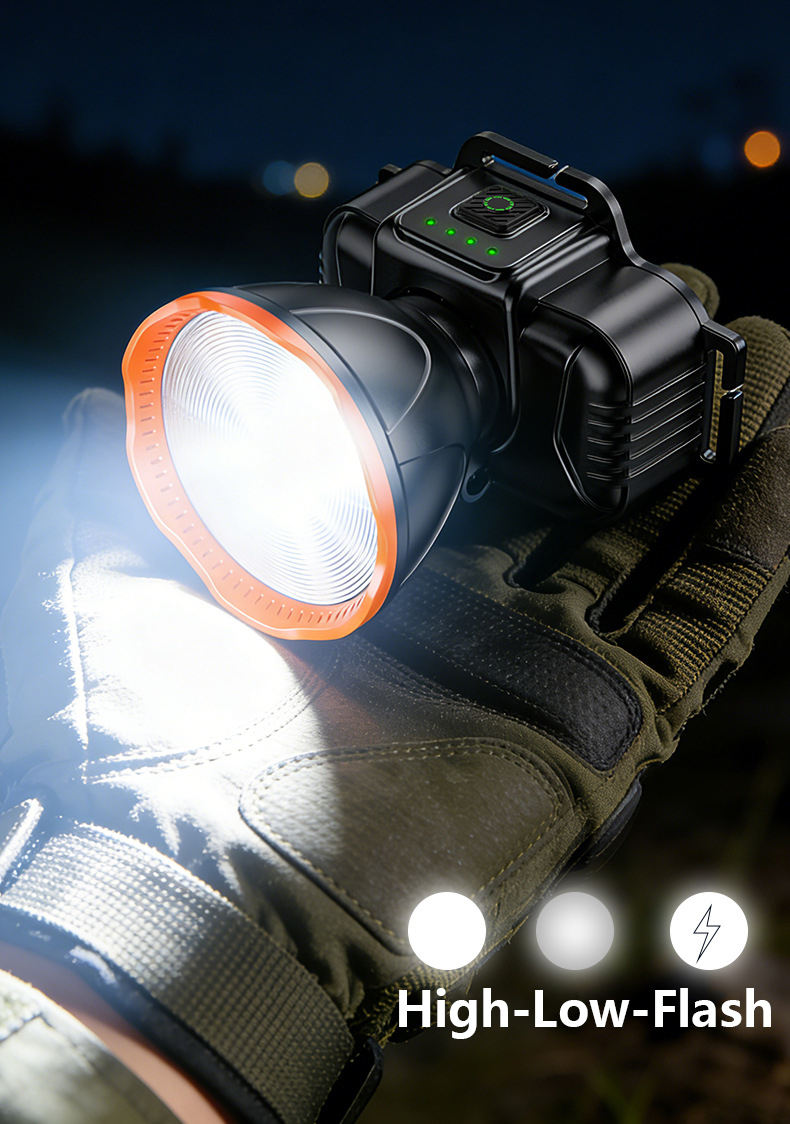
Beam mode determines the lighting range and focusing effect of a headlamp, directly affecting its adaptability to different outdoor scenarios. Traditional fixed headlamps only provide a single beam effect, resulting in poor flexibility, while high-quality modern outdoor headlamps support dual beam modes: spotlight and floodlight, and many premium models realize stepless adjustable beam angles.
Spotlight mode concentrates light into a narrow, high-intensity beam with long projection distance, usually reaching 100 to 200 meters. It is specially used for long-distance observation, including night hiking road condition judgment, mountain terrain observation, wild animal detection, and high-altitude obstacle inspection. The focused spotlight ensures long-distance clear vision without light dispersion, greatly improving the safety of night travel and exploration.
Floodlight mode diffuses light into a wide, uniform soft light range, covering a large-area near-field environment. It is suitable for close-range detailed work such as outdoor cooking, tent building, equipment sorting, fishing bait adjustment, mechanical maintenance, and camp environment lighting. The wide floodlight eliminates local dark areas, providing full-range soft lighting without dazzling eyes, effectively reducing visual fatigue during long-time use.
Dual-mode switchable and angle-adjustable headlamps perfectly meet the all-scenario lighting needs of outdoor users, realizing one lamp for multiple uses and avoiding the trouble of carrying multiple lighting devices.
Final Buying Suggestions for Different Users
To sum up, the perfect outdoor headlamp does not mean the highest brightness or the most complete functions, but the most matching configuration for your usage habits and scenarios. Casual users who only engage in occasional camping and night walking can choose 150-300 lumen rechargeable headlamps with IPX4 waterproof, lightweight body and dual beam modes. Frequent outdoor enthusiasts and night fishing lovers are recommended to select 300-600 lumen IPX5 waterproof sensor headlamps with adjustable angles for improved convenience. Professional explorers, construction workers and rescue personnel should prioritize 800+ lumen high-power IPX6 all-weather headlamps with dual-power design and ultra-durable structure for reliable outdoor performance all year round.
Post time: Jul-29-2026


