 fannie@nbtorch.com
 +0086-0574-28909873



Reliable illumination proves indispensable for professional adventurers. They operate in unpredictable, often dangerous, environments. Their success and survival depend on superior Outdoor Headlamps. These specialized devices offer critical advantages. Advanced headlamp technology directly impacts performance and safety, providing crucial benefits in extreme conditions. This technology ensures adventurers can confidently navigate any challenge.
Key Takeaways
- Outdoor headlamps help adventurers see clearly and avoid dangers in the dark, like hidden rocks or animals.
- Headlamps keep hands free for important tasks, like climbing or setting up camp, making adventures safer and easier.
- Good headlamps are tough and can work in bad weather, like rain or extreme cold, because they are built strong.
- Headlamps have different light settings, like bright for far away or dim for reading, and they save battery power.
- Comfortable headlamps stay on your head without bouncing, so you can focus on your adventure without pain.
Uncompromised Safety and Visibility with Outdoor Headlamps
Navigating Unseen Paths
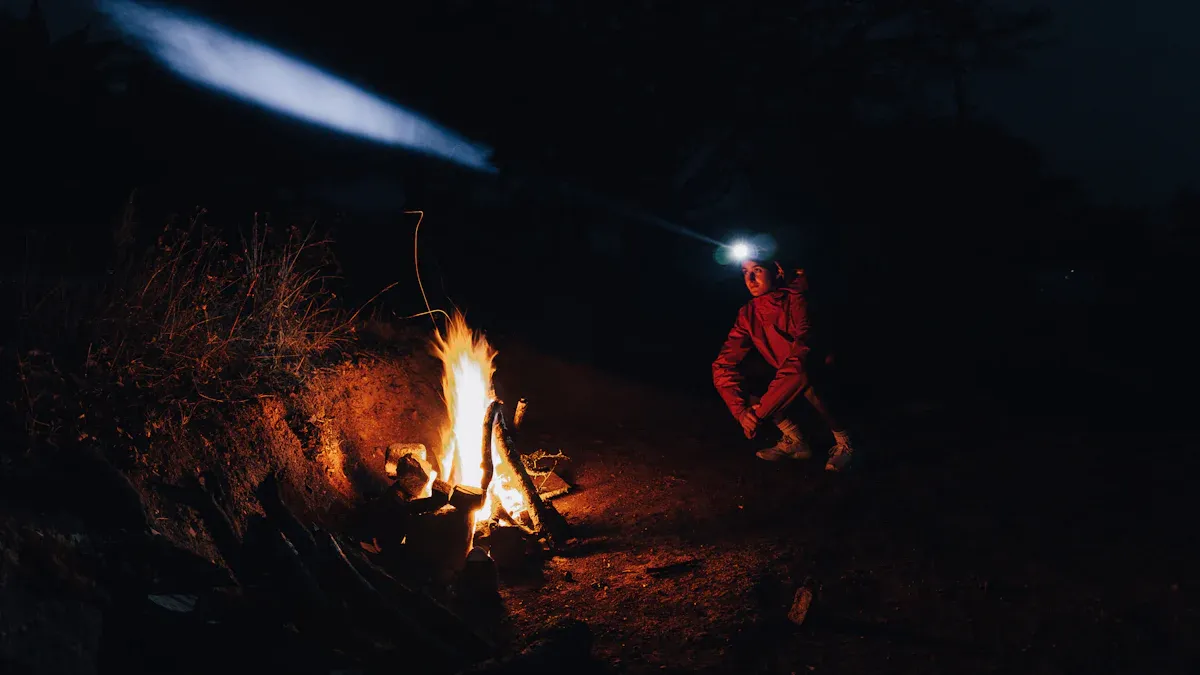
Professional adventurers demand clear vision. They frequently navigate challenging landscapes under the cover of darkness. Dense forest trails shrouded in darkness, expansive desert dunes cloaked in dusk, and unpredictable off-road environments with obstacles like rocks, sudden dips, and tree roots pose significant risks. Rocky trails and harsh weather conditions, including heavy rain, dense fog, snowstorms, or dust clouds, further complicate navigation. Outdoor Headlamps provide the essential illumination. They cut through these challenging conditions, allowing adventurers to identify safe routes and maintain their bearing. This prevents missteps and ensures continuous, confident progress through difficult terrain.
Detecting Hazards in Low Light
Low-light conditions effectively conceal numerous dangers. Adventurers face risks from unseen elements. Insufficient illumination can prevent the detection of hazards until it is too late to react, significantly increasing the risk of accidents. Common hazards frequently missed include challenging terrain with uneven surfaces, obstacles like hidden rocks and tree roots, and sudden changes in elevation. Environmental factors such as dust, fog, or heavy foliage also obscure potential threats. Wildlife or debris in the roadway often remain invisible until evasive action is no longer possible. Headlamps illuminate these critical areas. They reveal hidden crevasses, camouflaged wildlife, and other unexpected obstacles. This early detection allows adventurers to avoid potential injuries or dangerous encounters, ensuring their safety.
Essential for Emergency Signaling
Beyond navigation and hazard detection, headlamps serve a vital safety function: emergency signaling. In remote locations, adventurers might find themselves in situations requiring urgent assistance. A powerful beam from their Outdoor Headlamps can attract attention from a considerable distance. Its bright, focused light acts as an unmistakable beacon. This proves crucial for search and rescue teams attempting to locate individuals in distress. Many headlamps also feature specialized strobe or SOS modes. These pre-programmed patterns provide universally recognized signals, significantly increasing the chances of a swift and successful rescue operation.
Hands-Free Efficiency: The Convenience of Outdoor Headlamps
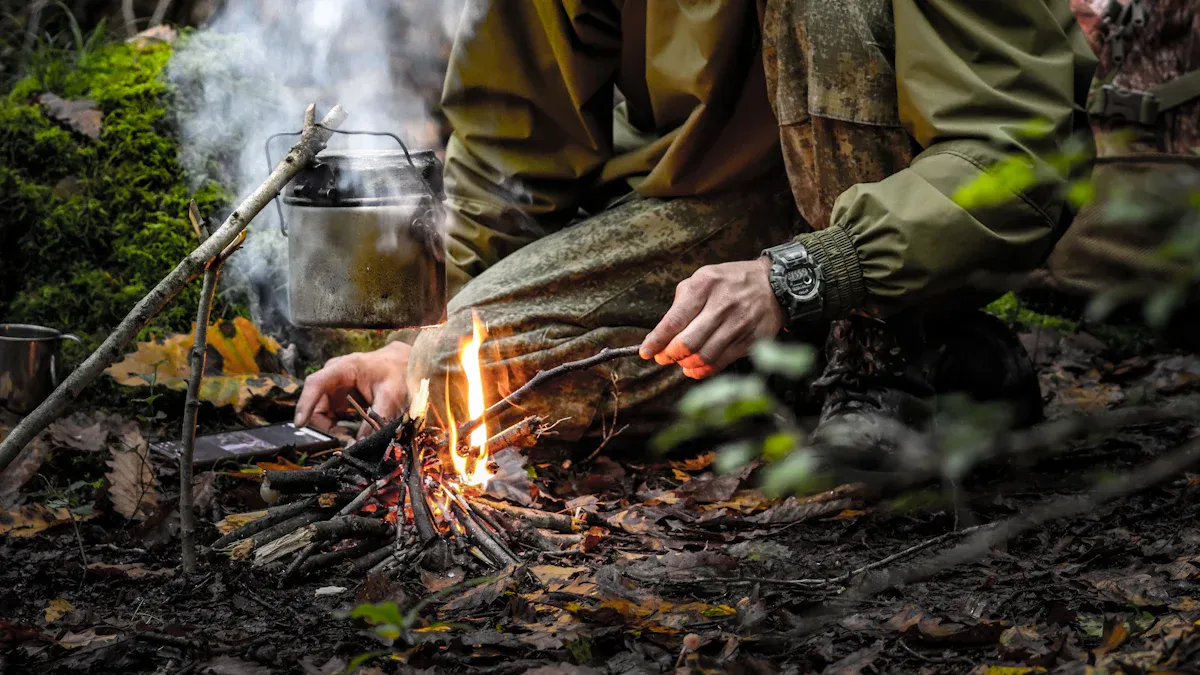
Professional adventurers understand the immense value of hands-free illumination. This capability transforms how they operate in challenging environments. It allows them to perform complex tasks, maintain stability, and manage their equipment with unparalleled ease.
Performing Critical Tasks Effortlessly
Adventurers often face situations demanding full use of their hands. A headlamp provides essential light without requiring a hand to hold it. This frees both hands for crucial operations. They can operate machinery or handle tools with greater precision. This reduces mishaps and improves efficiency. Working in confined spaces, such as manholes, crawl spaces, and tanks, often lacks fixed lighting. Headlamps allow both hands for maneuvering and tasks in these areas. Repairing a car, especially in dark conditions or underneath the vehicle, becomes much simpler. A headlamp frees hands for tools and tasks.
Maintaining Balance and Control
Navigating uneven terrain or performing physically demanding activities requires constant balance and control. Holding a flashlight compromises an adventurer’s stability. Headlamps eliminate this compromise. They allow individuals to use their hands for climbing, bracing, or holding onto safety lines. This enhances agility and reduces the risk of falls or accidents. Whether scaling a rock face or traversing a slippery path, adventurers maintain optimal control over their movements.
Streamlined Gear Management
Managing gear in dark or challenging conditions presents a significant hurdle. Outdoor Headlamps simplify this process. They provide hands-free illumination, allowing users to set up camp, prepare equipment, or navigate through wilderness without needing to hold a light source. This versatility and convenience make them essential for various activities requiring both light and the use of hands.
| Beam Type | Description | Ideal Use Cases |
|---|---|---|
| Flood Beam | Wide beam for short-range illumination | Cooking, reading, close-quarters tasks |
| Spot Beam | Focused beam for long-distance viewing | Navigating trails in the dark |
| Adjustable Beam | Allows switching between flood and spot beams for varied needs | Versatile for different tasks and environments |
Headlamps also offer specialized modes and alternative uses. A strobe mode is useful for emergency signaling. A red light mode preserves night vision and is ideal for reading without disturbing others. A tilt feature allows adjustment of the beam’s angle to illuminate the precise area needed. Adventurers can also use their headlamp as a flashlight by holding it in hand. They can create a lantern by wrapping it around a clear water bottle, turning it inward, and switching it on. It functions as a signal device by clicking it on and off. This is especially useful with knowledge of Morse code. Finally, headlamps keep hands free for charting and reading maps with compasses and other tools. This is particularly helpful when covered by a tarp or parka to avoid light pollution.
Versatility and Adaptability of Outdoor Headlamps
Excelling Across Diverse Environments
Professional adventurers operate in a multitude of challenging settings. Outdoor Headlamps prove indispensable across these varied landscapes. They are essential for activities such as hiking, trekking, camping, running, jogging, and hunting. Adventurers find them particularly useful in environments like mountain trails, dense forests, rocky paths, and steep terrains. For instance, navigating rocky paths during a hike, setting up camp in the wilderness, or spotting game while hunting all rely on effective hands-free lighting. Headlamps are also crucial for specialized pursuits like trail running and mountaineering, which demand specific gear for optimal performance. Their versatility extends to backpacking, climbing, and fishing, making them a core piece of equipment for any serious outdoor enthusiast.
Resisting Harsh Weather Conditions
The unpredictable nature of outdoor environments necessitates gear that withstands extreme elements. Professional-grade headlamps are engineered for resilience. They endure significant temperature fluctuations, tested to withstand conditions ranging from -35°C to 70°C. This rigorous testing involves rapid temperature shifts, ensuring reliability in freezing cold or intense heat. Furthermore, these devices undergo stringent water immersion tests, often achieving IPX8 waterproof ratings. This means they can function after being submerged in 2 meters of water for extended periods, even after impact. Headlamps also feature robust dust proofing and impact resistance, protecting internal components from fine particles and accidental drops. This unyielding durability ensures consistent performance regardless of rain, snow, dust, or rough handling.
Tailored for Activity-Specific Needs
Headlamp manufacturers design specific models with particular activities in mind. For trail running, adventurers seek high-quality headlamps that are lightweight, durable, and dependable. Climbers benefit immensely from hands-free operation, as both hands remain free for crucial maneuvers. Many models feature robust construction and top-grade materials, offering protection against water, dust, and impact. Lightweight and packable designs are common, making them easy to carry. Some headlamps incorporate a patented SPORT headband fit system for convenient one-handed adjustment. Others combine a headlamp and flashlight, often with magnetic tails or body clips for versatile hands-free fixation. Adjustable tilt beams allow precise lighting control, while red light modes preserve night vision. Quality LEDs boast lifespans up to 50,000 hours, ensuring long-term reliability. Carrying a smaller backup light is also a common practice, covering areas the main headlamp might miss or serving as a contingency against failure.
Key Features Professional Adventurers Demand in Outdoor Headlamps
Professional adventurers rely on their gear to perform flawlessly under extreme conditions. Their headlamps are no exception. They seek specific features that guarantee reliability, performance, and safety in the most challenging environments.
Optimal Lumens and Beam Patterns
The right amount of light and its distribution are paramount for adventurers. Lumens indicate a headlamp’s brightness. Different activities require varying lumen outputs for optimal visibility.
| Activity | Recommended Lumens |
|---|---|
| Camp (cooking, reading) | 100 to 150 lumens |
| Technical (mountaineering) | 300 lumens or more |
Beyond brightness, beam patterns dictate how a headlamp projects light. Adventurers choose patterns based on their specific needs:
- Flood Light: This beam emits a wider, more dispersed light. It provides ample illumination in close proximity, typically up to a 50-foot range. Adventurers use flood beams for tasks like night-time repairs, observing terrain on trails, cooking, or reading. It enhances peripheral vision and simulates daylight conditions at close range. Lower lumen counts often suffice for flood mode, leading to longer run times.
- Spot Beam: A spot beam offers a narrow, concentrated, and long-reaching light. It can illuminate objects up to a mile away. This pattern is best for open terrain, high-speed off-road driving, or scanning distant areas for hazards or trail markers. Spot beams typically require higher lumen counts to project light effectively over long distances, which generally uses more energy and results in shorter run times.
- Spot-Flood Light Combo (Hybrid Beam Pattern): Many professional Outdoor Headlamps offer a combination of both spot and flood lights. This provides versatile illumination for nearby areas and the distant trail ahead. Spot lights usually sit in the center, with flood lights on the outer edges. Hybrid light bars offer versatile beam patterns and high total output. They provide balanced illumination and adapt to changing conditions. However, they often have higher power draw and generate more heat. Dual-beam or multiple-beam settings combine the long throw of a spotlight with the broad coverage of a floodlight. This offers versatility for activities like trail running or fast-paced hiking. Users identify distant trail markers and nearby objects without switching modes.
| Feature/Application | Spot Beam | Flood Beam |
|---|---|---|
| Primary Function | Distance and focus | Wide area coverage |
| Beam Characteristics | Narrow, concentrated, long-reaching | Wide, spread out, less distance |
| Ideal for Speed | High-speed off-road driving, fast desert sprints | Slow technical trails, crawling over rocks |
| Terrain/Environment | Long, open trails, desert runs, supplementing headlights | Worksite/camp lighting, foggy/dusty conditions, woods, trails, campsites |
| Benefits | Spot obstacles sooner, maximum reach, extends visibility | See rocks/ruts around vehicle, illuminates whole area, reduces glare |
Extended Battery Life and Power Solutions
Reliable power is non-negotiable for adventurers. They often operate far from power sources, making extended battery life crucial. Professional headlamps feature efficient power management systems. These systems maximize run time without compromising brightness. Many models offer rechargeable batteries, providing a cost-effective and environmentally friendly solution. Some also accept standard disposable batteries, offering flexibility in remote areas where recharging is not possible. Adventurers often carry spare battery packs or power banks to ensure continuous illumination during multi-day expeditions.
Unyielding Durability and Construction
Professional adventurers subject their gear to extreme stress. Their headlamps must withstand harsh environments. Manufacturers employ robust materials and construction techniques to ensure unyielding durability.
- Materials: High impact non-corroding ABS plastic provides chemical resistance. This material protects internal components from corrosive substances encountered in various outdoor settings.
- Design: Headlamp designs often avoid hinges. This eliminates common points of weakness, enhancing overall structural integrity. A cylindrical shape and specialized seals contribute to 100% waterproofing. This design expertise often comes from scuba diving light manufacturing, ensuring reliability even after submersion.
Industry standards and certifications validate a headlamp’s resilience.
- IK Code (Impact Protection Code): This rates the degree of protection enclosures provide against external mechanical impacts. An IK08 rating, for example, indicates a headlamp’s ability to withstand a specific impact energy, ensuring structural integrity under physical stress.
- MIL-STD-810G: This military guideline outlines rigorous testing procedures for environmental engineering considerations and laboratory tests. This standard ensures equipment endures challenging conditions, including higher degrees of humidity, significant temperature variations, dust, low pressures, and mechanical impacts.
- IP Rating (Ingress Protection): An IP rating is a standardized system indicating an electronic device’s protection level against solid and liquid contaminants. It appears as ‘IPXX’. The first digit denotes resistance to dust (solids), and the second digit indicates resistance to liquids. For example, an IP67 rating means a headlamp is completely dustproof and can withstand water submersion up to 1 meter deep for 30 minutes. This makes it suitable for harsh conditions like coastal, dock, factory, and construction environments. IPX7, a component of IP67, specifically indicates waterproof capability up to 1 meter for 30 minutes, excellent for environments with risks of accidental submersion.
These rigorous standards ensure professional-grade headlamps perform reliably when adventurers need them most.
Specialized Modes and Intuitive Controls
Professional adventurers demand more than just basic illumination from their headlamps. They require specialized lighting modes and intuitive controls. These features allow quick adaptation to changing conditions and specific task requirements. Advanced headlamps offer a range of modes, each designed for optimal performance in different scenarios.
| Lighting Mode | Brightness/Visibility | Burn Time |
|---|---|---|
| Reactive Lighting® (White Mode) | 18 to 100 lm (optimized via sensor adjustment) | 10 to 70 hours (with 2-hour reserve at 10 lm) |
| Standard Lighting (White Mode) | 25 to 1100 lm (depending on setting) | 2 to 45 hours (depending on setting) |
| Extended Standard Lighting (White Mode) | 10 to 700 lm (depending on setting) | 2 to 100 hours (depending on setting) |
| Standard Lighting (Red Mode) – Continuous | 3 lm | Up to 60 hours |
| Standard Lighting (Red Mode) – Strobe | Visible at 750 m | Up to 300 hours |
The chart below visually represents the brightness and burn time capabilities across various lighting modes, highlighting the efficiency and power of modern headlamps.
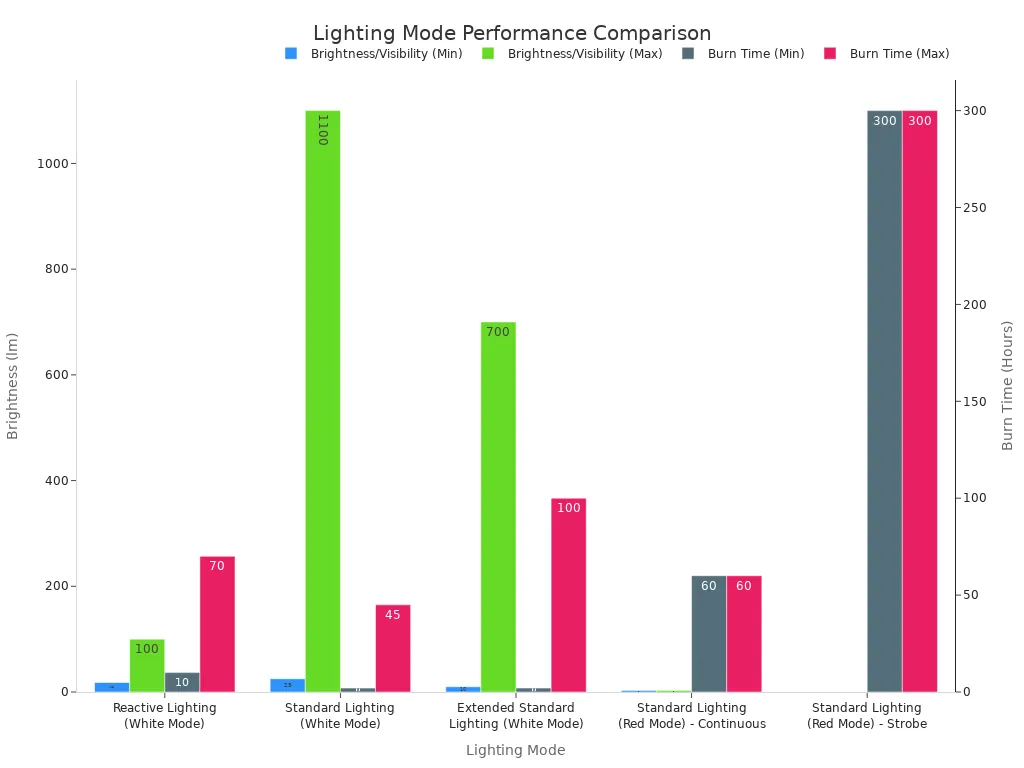
Reactive Lighting mode stands out as a significant innovation. Headlamps like the Petzl Swift RL utilize an automatic sensor. This sensor adjusts beam intensity and pattern, optimizing battery use. It also provides visual comfort. This mode eliminates the need for manual adjustments. It ensures the headlamp delivers the appropriate amount of light for tasks like scanning a ridgeline or reading a map. The Black Diamond Distance 1500 headlamp also incorporates this technology. It automatically adjusts beam intensity based on the user’s surroundings.
Beyond reactive lighting, headlamps offer other crucial modes. Continuous red lighting preserves night vision during close-up tasks. It does so without disturbing surroundings or other team members. A strobe mode provides a flashing signal for emergency visibility. This feature can be seen in the Black Diamond Distance 1500 headlamp, which offers a comprehensive set of lighting options.
| Feature | Detail |
|---|---|
| Max Output | 1500 lumens (Reactive lighting mode) |
| Lighting Modes | Reactive, standard, dim, strobe, red night vision |
Intuitive controls complement these specialized modes. Adventurers need to change settings quickly and easily, even with gloved hands or in stressful situations. Simple button layouts, often with a single multi-function button, allow seamless transitions between brightness levels and beam patterns. This design minimizes distraction and maximizes operational efficiency.
Superior Comfort and Secure Fit
Professional adventurers often wear headlamps for extended periods. Therefore, superior comfort and a secure fit are non-negotiable. A poorly fitting headlamp can cause discomfort, headaches, or even become a safety hazard if it bounces or slips during strenuous activity. Manufacturers design headlamps with several key elements to ensure optimal wearability:
- Lightweight design, specifically engineered for athletic use, minimizes weight and prevents bouncing during runs.
- Secure fit prevents bouncing during strenuous activity.
- Padded straps enhance comfort during extended wear.
- Multiple size adjustments ensure a snug and personalized fit.
- Moisture-wicking materials help manage sweat and maintain comfort.
- Balanced weight distribution prevents uncomfortable bouncing and neck strain.
- Revolutionary headband systems, such as the AIRFIT, eliminate compressive pressure and sweating issues, offering an ultralight feel.
Headlamps engineered for athletic use feature lightweight designs. These designs minimize overall weight and prevent bouncing during dynamic movements like running or climbing. A secure fit is paramount. It ensures the headlamp remains stable on the head, even during vigorous activity. Padded straps enhance comfort, especially during extended wear. Multiple size adjustments allow adventurers to achieve a snug and personalized fit. This accommodates different head sizes and headwear.
Moisture-wicking materials are often integrated into the straps. These materials help manage sweat, keeping the wearer dry and comfortable. Balanced weight distribution is another critical factor. It prevents uncomfortable bouncing and reduces neck strain, allowing adventurers to focus on their tasks. Some headlamps feature revolutionary headband systems, like the AIRFIT. These systems eliminate compressive pressure and sweating issues. They offer an ultralight feel, making the headlamp almost unnoticeable. These design considerations collectively ensure that professional adventurers can rely on their headlamps for comfort and stability, no matter how challenging the environment.
Outdoor headlamps are more than just gear; they are vital companions for professional adventurers. A strategic investment in high-quality headlamps empowers these individuals. They gain hands-free operation, customizable lighting, enhanced safety, and energy efficiency. This reliability provides peace of mind, ensuring safety and efficiency in challenging conditions. Adventurers can confidently push boundaries, knowing reliable illumination supports their every move.
FAQ
What lumen output is best for outdoor headlamps?
Optimal lumen output depends on the activity. Camp tasks require 100 to 150 lumens. Technical activities like mountaineering demand 300 lumens or more. Adventurers match brightness to their specific needs for effective illumination.
How crucial is battery life for professional adventurers?
Battery life is extremely crucial. Adventurers often operate far from power sources. Professional headlamps feature efficient power management. They maximize run time. Many use rechargeable batteries. They also accept disposable ones for flexibility in remote areas.
What do IP ratings signify for headlamp durability?
IP ratings indicate a headlamp’s protection against solids and liquids. For example, IP67 means it is dustproof and submersible up to 1 meter for 30 minutes. These ratings ensure reliability in harsh conditions like rain or dust.
Why do professionals choose headlamps over traditional flashlights?
Professionals choose headlamps for hands-free operation. This allows them to perform critical tasks effortlessly. They maintain balance and control. Headlamps also streamline gear management. This enhances safety and efficiency in challenging environments.
Post time: Jun-17-2026


