 fannie@nbtorch.com
 +0086-0574-28909873



- Spec lanterns zone by zone — dining canopies want stepless dimming, tent decks want glare-free mid light, and emergency kits want simple high output.
- Buy measured lumens, not label lumens: demand an integrating-sphere report, because label claims without measurement drift far from reality.
- For hospitality duty cycles, dimming range and battery capacity beat peak output; our retro resort lantern pairs a 260 lm ceiling with a 2000 mAh 18650 cell.
- Warm colour temperatures around 2200–3000 K and retro materials drive the guest photos that market your resort for free.
- Require an IEC 60529 IP rating, lithium battery safety documentation, and — for EU properties — EU Battery Regulation 2023/1542 readiness before you sign.
Buying lanterns for a glamping resort is not a flashlight purchase scaled up — it is a lighting-design decision wearing a procurement hat. The three spec pillars are output, endurance and appearance, and they trade against each other constantly. Lumens should be specified per zone, with stepless dimming for guest-facing areas and honest, lab-measured numbers rather than marketing claims. Runtime should be planned around your housekeeping reality — one charge should survive a full evening service with headroom, and the charging interface must match how your team actually tops units up. Aesthetics are the pillar most buyers underestimate: warm light in the 2200–3000 K range, retro silhouettes and tactile materials are what guests photograph, and those photographs are your cheapest marketing channel. I am Lily, Technical Director at Mengting; my bench has built outdoor lighting for more than 15 years, and resort programmes have taught me that a lantern is furniture, atmosphere and safety equipment at the same time. Here is how I would write your RFQ.
Map the Lighting Zones Before You Spec a Single Lumen
The fastest way to overpay for lanterns is to buy one SKU and hope it works everywhere; the fastest way to disappoint guests is the same. A resort is a set of lighting zones with conflicting needs, and I map them before I recommend anything. Because hospitality lighting is judged by atmosphere rather than peak brightness, we spec the dimming range before we spec maximum output. The zones we use as a starting template:
- Dining canopies and fire pits. These spaces need warm, steplessly dimmable lanterns that drop to candle-like levels without flicker, because conversation lighting sitting high above its dimming floor reads as a construction site, not a dinner.
- Tent interiors and private decks. Guests want a hangable unit with a soft, wide beam and no visible LED dots — a diffused glow they can read by at full setting and relax under at low setting.
- Pathways and steps. Wayfinding needs low, shielded light that marks the route without flooding the night sky or washing out the stars guests came to see.
- Washrooms and spa zones. Splash resistance becomes the dominant requirement here, and units must survive steam, spray and cleaning agents without fogging.
- Emergency and backup kits. Storms and grid dips demand a separate stock of simple, high-output units with obvious controls and long shelf tolerance, stored where staff can reach them in the dark.
When buyers send us a resort floor plan or even a rough site sketch, we tag each zone with an output band, a colour temperature and an ingress requirement first — only then do we open the catalogue. That sequence saves money, because the cheapest correct unit usually beats the expensive universal one.
Lumens, Measured Honestly: Why Label Numbers Lie
A lumen is the total quantity of visible light a source emits in all directions, and it is only meaningful when measured under defined conditions. That definition follows the CIE International Lighting Vocabulary, and the “defined conditions” part is where procurement goes wrong. Because integrating-sphere measurement is the only way to capture total luminous flux independently of beam shape, we verify every lantern SKU in our own sphere here in Ningbo before the number reaches a datasheet.
Here is the uncomfortable truth from our bench: when we put competitor units carrying impressive label claims into our sphere, a meaningful share of them measured clearly below their advertised output, and the gap was widest exactly in the budget segment where resorts try to save. The lesson I give every resort buyer is blunt — ask for the measurement, not the number:
- Request the integrating-sphere report for the exact SKU and production batch you are buying, not for a hand-picked golden sample.
- Ask for the dimming floor as well as the ceiling: a lantern that dims to 1–3 lm is a different product from one that bottoms out at 40 lm, and your dinner guests will know the difference.
- Treat “max mode” claims with suspicion if the vendor cannot also state the current draw at that mode, because output and endurance are two ends of the same battery budget.
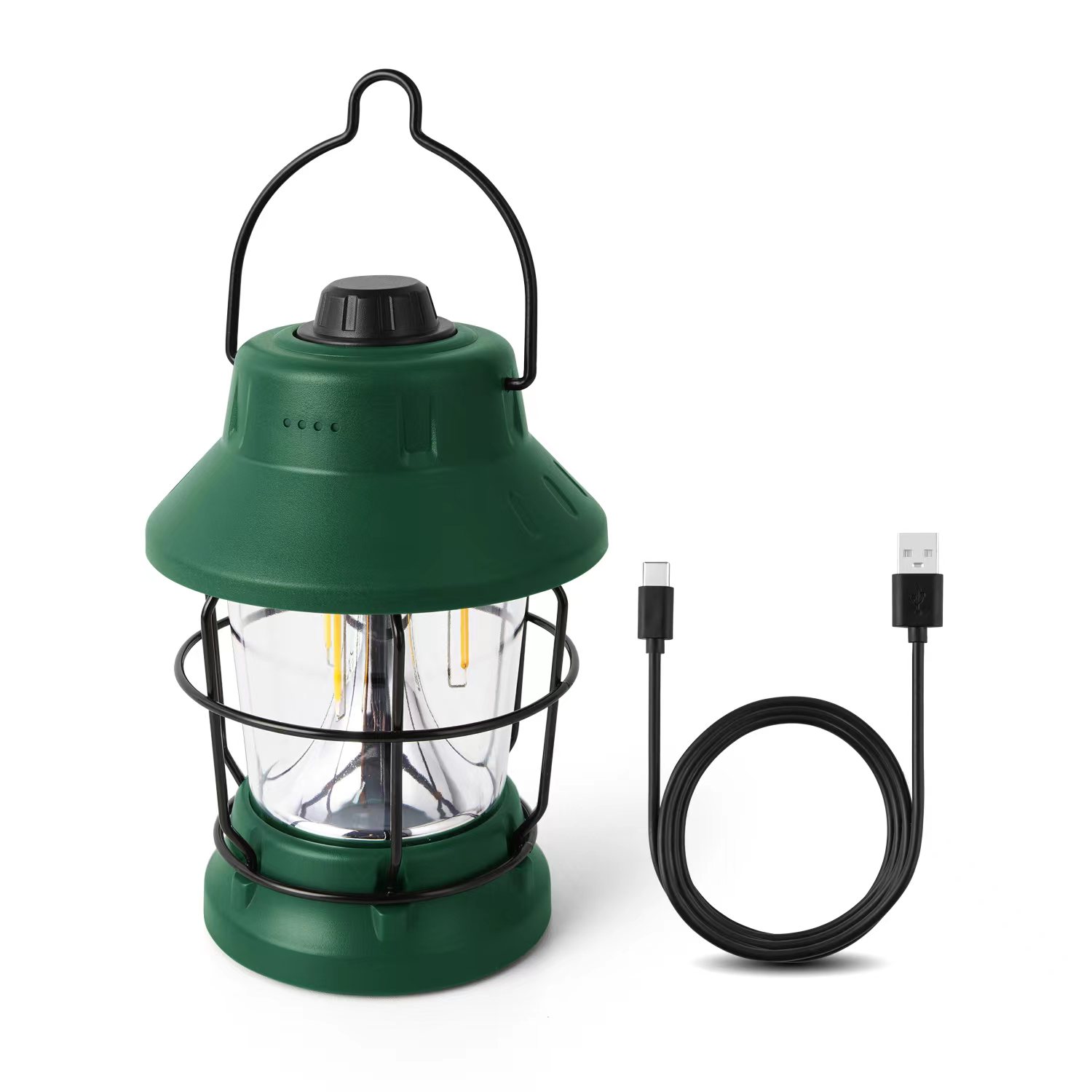
Our reference resort unit is a good example of honest numbers. The retro lantern we ship to hospitality buyers is rated at 260 lumens at full output — three warm-white tube emitters plus 18 white LEDs behind a stepless rotary dimmer that sweeps from 0 to 260 lm. For a glamping deck, 260 lm of dimmable warm light is more useful than 1000 lm of fixed cold light, because atmosphere is the product you are actually selling. Reserve the four-figure-lumen units for emergency stock, where their job is function rather than mood.
Runtime Math for a Two-Session Service Day
Runtime is a duty-cycle problem, not a battery-capacity headline. A resort lantern lives a double life: an evening guest session followed by a morning housekeeping turnaround, and your spec must cover both without a mid-service failure. The capacity number on a datasheet only becomes runtime once you divide it by the actual current draw of the mode in use — so the document you want from a supplier is a measured runtime curve per mode, not a single hero number.
Our retro resort unit runs on one 18650 lithium cell rated at 2000 mAh, and the three-source architecture is deliberate: the tube filaments alone for mood evenings, the white LED ring alone for task light, and both together at full for the moments staff actually need reach. Stepless dimming is the runtime multiplier here — a lantern idling near its dimming floor sips power compared with full output, which is why we treat dimming depth as an endurance feature, not just a comfort feature. Because housekeeping recharges dozens of units every single day, the charging interface and the charge indicator matter more to a resort than any spec-sheet capacity figure. Type-C charging with a visible battery indicator means your team plugs the right cable without thinking and knows at a glance which units are ready for tonight — that operational detail prevents the classic failure mode of a guest receiving a half-charged lantern.
Two compliance notes for runtime specs. First, if your resort sits in the EU, the batteries inside your lanterns fall under Regulation (EU) 2023/1542, which phases in labelling, QR-code information and due-diligence duties for cells placed on the European market — ask your supplier how the lantern’s documentation will meet those obligations. Second, lithium cells must have passed the UN 38.3 transport test suite before they may legally fly or sail to you; a supplier that cannot produce the current test summary is a supplier whose shipment can be stopped at a freight terminal. We keep both documents on file as standard.
The Aesthetic Brief: Warmth, Materials, and the Photo Test
Guests photograph warm-lit scenes far more often than cool-lit ones, which makes colour temperature a marketing lever rather than a comfort footnote. Every image a guest posts of your deck at dusk is an advertisement you did not pay for, and the lantern sits at the centre of that frame. The aesthetic spec therefore deserves the same rigour as the electrical spec:
- Colour temperature: target warm white in the 2200–3000 K range for guest-facing zones; anything cooler starts to read as industrial and flattens skin tones in photos.
- Visible light source: exposed LED dots kill the retro mood instantly, which is why our tube emitters mimic filament glow behind a diffuser instead of showing the chip.
- Silhouette and texture: the barn-lantern shape our retro line uses — PC body over an iron frame, 99 × 147 × 85 mm and 385 g — reads as intentional design on a wooden deck, and the metal handle is a detail fingers notice when guests carry units back to their tents.
- Consistency: buy one visual family across zones; mismatched lantern shapes in one sightline are the lighting equivalent of mismatched chairs, and guests register it even if they cannot name it.
One of my favourite validation rituals is what I call the photo test: we set a lantern on a timber surface, dim it to evening level, and shoot it with a phone camera the way a guest would. If the image looks flat or the light reads blue, the unit does not ship to a resort regardless of what the sphere says. Aesthetically, the lantern is the one category where the spec sheet can be perfect and the product still wrong — trust the camera first, then trust the instruments.
Durability and Safety: The Spec Lines Buyers Skip
A resort lantern crosses environments every day — outdoor dew at night, cleaning sinks in the morning — so its enclosure spec must cover both worlds. The language for that is the IP code defined in IEC 60529, and for hospitality duty I insist buyers ask for the actual test report instead of accepting “waterproof” as a marketing word. Splash and spray resistance protects against rain on the deck and against the pressure rinse your housekeeping team will inevitably apply.
The durability list we build into resort programmes:
- Drop tolerance: lanterns fall off decks and truck trays; we verify housings and light-source mounting against repeated drop tests on wood and concrete, because a cracked diffuser in week three is a guest complaint, not a lab curiosity.
- Cell safety documentation: lithium cells should arrive with current UN 38.3 transport test summaries and safety data documentation; we treat these as shipping prerequisites, not optional extras.
- Storage tolerance: emergency stock sits half-charged for months, so we validate self-discharge behaviour and recommend a periodic top-up calendar with the delivery.
- Serviceability: ask whether the charging port, hook and diffuser can be replaced in the field — a resort cannot send a fleet overseas for a broken handle.
Why does this rigour matter commercially? Because the demand side keeps climbing. According to the UN Tourism statistics programme, international arrivals have recovered to pre-pandemic scale and outdoor-oriented stays are among the fastest-evolving segments, while the European Commission’s tourism pages document how central the sector has become to the EU economy. Because resorts are adding capacity to meet that demand, procurement mistakes now scale across dozens of units instead of five — which is exactly why the boring spec lines earn their place in the RFQ.
What We Recommend to Resort Buyers from Our Bench
After mapping zones to products across our programmes, here is the shortlist I actually propose to glamping buyers, all drawn from our camping lantern catalogue:
- The ambient hero: the retro knob-dimming lantern described above — 260 lm stepless dimming, warm tube filaments, hangable iron frame, Type-C charging. It carries dining canopies and tent decks, and its silhouette survives the photo test every time.
- The task and emergency unit: our 1000 lm battery-indicator lantern with four light modes and a waterproof build — this is the unit for storm cupboards, maintenance carts and the front desk drawer.
- The canopy layer: 33-foot USB-powered string-light runs with integrated backup lighting for dining structures, so the overhead plane stays softly lit even when table lanterns are collected.
- The fleet logic: one charging standard (Type-C across the fleet), one visual family, and a spare ratio agreed at order stage so housekeeping never cannibalises guest units.
Every programme we ship runs through our in-house verification — integrating-sphere photometry, rain testing, temperature-humidity cycling and aging runs — before it leaves Ningbo, and our wider outdoor lighting range means we can extend the same quality discipline from lanterns to path lights and work lights when your resort grows its scope. We have been exporting since 2014, and resort buyers from seasonal campsites to permanent luxury sites have taught us one constant: the purchase order is the easy part, and the re-order is the real verdict. When you are ready to compare options against your own site plan, our Contact Us page reaches the engineering team directly — no sales relay.
The RFQ Table: Spec Fields Your Inquiry Should Contain
Copy this table into your inquiry and ask every candidate supplier to complete it line by line. Gaps in the answers tell you more than the answers themselves:
| Spec field | What to request | Why it matters |
|---|---|---|
| Luminous flux | Integrating-sphere report for the production SKU and batch | Label lumens without measurement drift far from reality |
| Dimming range | Measured floor and ceiling in lumens, plus stepless or stepped behaviour | The dimming floor decides whether dinner lighting reads as ambience or floodlight |
| Colour temperature | CCT per mode in kelvin, measured not nominal | Warm 2200–3000 K light drives guest photography and perceived comfort |
| Battery | Cell chemistry, capacity in mAh, and UN 38.3 transport test summary | Capacity sets endurance; documentation sets whether the goods can legally reach you |
| Runtime curves | Measured runtime per mode with the cutoff criterion stated | One hero number hides how fast output decays during service |
| Charging | Interface standard, full-charge duration, and charge-state indication | Housekeeping throughput depends on cable uniformity and visible state |
| Ingress protection | IP code with the test report behind it | Resort units face rain, steam and cleaning spray, not just drizzle |
| Mechanical durability | Drop-test conditions and results; hook, port and diffuser serviceability | Hospitality duty cycles break products that survive weekend camping |
| Compliance | CE/RoHS conformity and EU Battery Regulation 2023/1542 readiness for EU properties | Missing paperwork surfaces as customs holds and marketplace delistings |
| Customisation | Logo, colour and packaging options with the approval workflow described | Branded units turn lighting into part of your resort identity |
| Warranty and spares | Warranty period, response time, and field-replaceable parts list | A resort cannot ship a fleet overseas for a broken handle |
Frequently Asked Questions About Resort Lantern Procurement
How many lumens does a glamping tent actually need?
For tent interiors and private decks we recommend dimmable lanterns whose ceiling sits in the low hundreds of lumens, because that range covers reading at full output and relaxed ambience near the dimming floor. Four-figure-lumen units belong in emergency stock, not on guest decks, where their fixed brightness works against atmosphere.
Which colour temperature suits hospitality ambience?
Warm white between 2200 K and 3000 K is the hospitality range: it flatters skin tones, complements timber and canvas, and photographs beautifully at dusk. Neutral or cool white is appropriate only in task zones such as maintenance areas, where colour rendering for work matters more than mood.
How long should a lantern run between charges?
Plan for one full evening guest session with headroom — specify the requirement to your supplier as a measured runtime per mode rather than a single number, and check the behaviour near the dimming floor where most resort hours are actually spent. Pair that with a charging indicator your housekeeping team can read at a glance.
What IP rating should resort lanterns carry?
Ask for a documented IP code backed by a test report, rated at minimum for splash and spray, because resort units meet rain on the deck, steam in wash zones and water during cleaning. A written IP claim without the report behind it is marketing, not specification.
Solar or USB-rechargeable: which fits resort operations better?
USB-rechargeable fleets win in resort operations because charging throughput is predictable and weather-independent, while solar units depend on sun exposure that housekeeping cannot schedule. Solar still earns its place in remote pathway fixtures, but for guest-facing lanterns the controlled charge cycle is the operational advantage.
Can lanterns be customised with our resort brand?
Yes — we run logo, colour and packaging customisation as a standard OEM/ODM service, with samples sent for your inspection before order confirmation and a design-and-package step built into the workflow. Branded units photographed by guests then carry your identity into every social post they publish.
Lily
Technical Director, Ningbo Mengting Outdoor Implement Co., Ltd.
15+ years in outdoor lighting, leading LED headlamp and flashlight R&D, thermal management and product innovation at our Ningbo factory, founded in 2014. I personally run the photo test on every resort-bound lantern before it is approved for shipment. Follow my bench notes on Instagram, Facebook and YouTube.
Send us your resort site plan or a simple zone list — we will map it to output bands, colour temperatures and ingress classes, and return a lantern fleet proposal with measurement reports attached.
Post time: Aug-28-2026


