 fannie@nbtorch.com
 +0086-0574-28909873



TL;DR
- ODM hands you a working product; OEM hands you a designed one. In portable lighting the difference shows up most sharply in thermal management, because that is where portable lighting products actually differentiate.
- Decide by what you intend to change. Appearance, packaging, and mode configuration are commonly handled under ODM. Optics, thermal architecture, and drive current are where OEM earns its place.
- Portable lighting has three variables that move independently: light source, battery, and thermal path. Changing one under ODM often forces changes in the other two.
- Most brands end up mixed — ODM for the catalogue and OEM for the product they intend to build a reputation on.
The ODM-versus-OEM question gets answered generically in most sourcing guides, usually as a volume-versus-customisation trade-off. In portable lighting that framing misses what actually distinguishes the two models, because this category has a specific technical dependency that other consumer-electronics categories do not.
Portable lighting products live or die by thermal management. A headlamp rated at a headline lumen figure is only that figure if the heat path holds, and the heat path is a design decision rather than a specification you can change later. That single dependency is why the ODM/OEM question in this category is more consequential than it sounds.
Ningbo Mengting Outdoor Implement, which has run ODM and OEM service since 2014, makes the operating distinction explicit: development begins from either the supplier’s recommendation or your own design. Everything downstream of that choice follows from it.
What Actually Separates ODM From OEM in This Category
Both models run through the same factory. The difference is whether the factory’s engineering owns the product or yours does. In portable lighting, that ownership question runs straight into the thermal design, which is where it becomes consequential.
Under ODM, the factory has already solved the problem. It has an existing design that it knows works, because it has been produced repeatedly. You change what is changeable without re-engineering the core — and in this category the changeable surface is larger than most buyers expect. Published customisation options for this class of supplier include special appearance design, different material choice, adjustable light modes, and battery choices.
Under OEM, your design drives. That matters when the product you want is genuinely different rather than differently branded, and it carries two costs people underestimate: you carry the engineering risk, and you carry the validation burden. Under ODM the factory has already run the lumen, thermal, and functional tests on a design it knows; under OEM someone runs them on yours for the first time.
The Three Variables That Move Independently
Portable lighting has three variables that can each be changed on their own in principle but interact in practice: the light source, the battery, and the thermal path. Understanding this is what lets you judge whether an ODM conversation can satisfy your requirement or whether it needs to become an OEM one.
The light source
COB and multi-emitter arrays behave differently from discrete LED packages, and the difference shows up as luminous efficacy per unit area and as thermal concentration. A COB array concentrates heat in a smaller footprint, which is why the same lumen figure from a COB source typically demands more attention to the heat path than the same figure from a distributed array.
The published specification for a representative product in this category states LED plus COB output at 200 lumens, which sits at the work-light end of the range rather than the high-lumen end. That is a deliberate positioning: the value of a COB work light is usable broad-area illumination rather than a headline number.
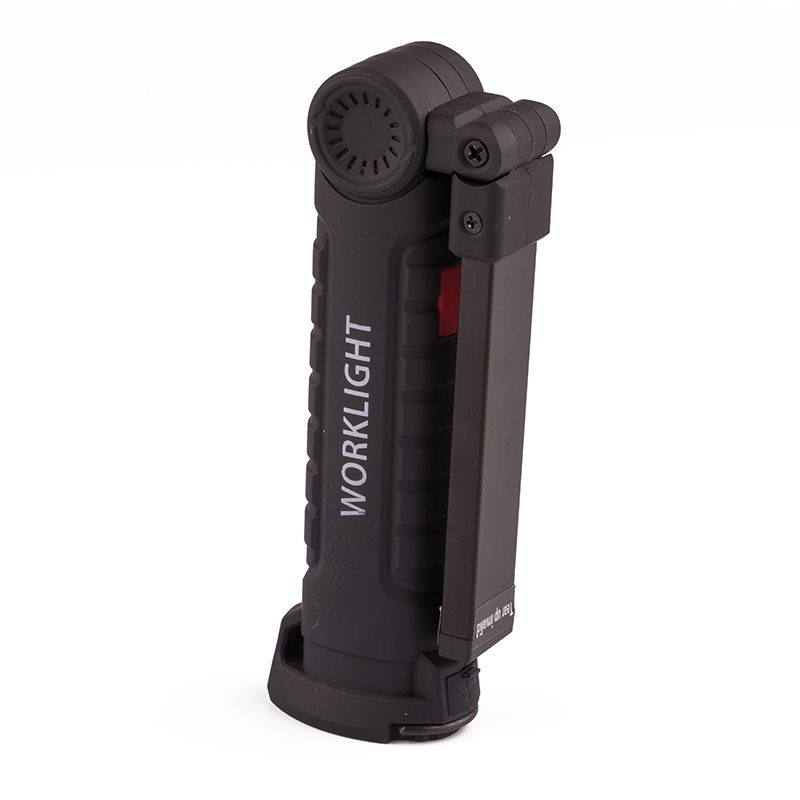
The COB work light with magnetic base is a useful reference point for this, because its five modes span broad-area white through to red warning and strobe — a mode set built around task situations rather than around a single headline output.
The battery
Battery choice is the variable buyers most often expect to be trivial, and it is the one that most reliably forces a design conversation. Cell chemistry sets the discharge profile, which sets the thermal load under sustained high output. A higher-capacity pack held in the same housing runs warmer for longer, and that heat has to go somewhere.
The representative specification cites a 1200mAh 18650 lithium cell in a housing measuring 35 × 48 × 247 mm folded to 147 mm, at 135 g net. Those figures together describe a compact folded format, and the cell capacity is sized to it. Moving to a larger cell in the same envelope is not a component swap.
The thermal path
This is the variable that ties the other two together, and it is where ODM and OEM diverge most sharply. The published construction detail for this class of work light is worth noting precisely: the body is hard rubber with anti-sweat and anti-slip properties, and the head is aluminium, which dissipates heat effectively and resists water.
That division of materials is a thermal decision, not a cosmetic one. The aluminium head exists because it conducts; the rubber body exists because it does not, and because it grips. Change the head material and you change the thermal performance; change the body material and you change handling and ingress characteristics. Neither is a styling preference.
Where the three variables collide
Here is the practical consequence. If you ask an ODM supplier to raise output, improve runtime, and change form factor simultaneously, you have asked for three coupled changes to a design whose thermal path was sized for the original combination. That request is an OEM request, whether or not it arrives under an ODM label.
ODM or OEM: What Each Is Actually Good For
| Dimension | ODM | OEM |
|---|---|---|
| Design ownership | Supplier | Your brand |
| Time to first sample | Short | Longer |
| Engineering risk | Supplier’s | Yours |
| Appearance and packaging | Strong fit | Strong fit |
| Light modes and configuration | Strong fit | Strong fit |
| Thermal architecture changes | Limited | Required |
| Differentiation that survives comparison | Weak | Strong |
| Best for catalogue expansion | Yes | Not required |
| Best for a flagship product | Rarely | Yes |
Two rows in that table carry most of the argument. “Thermal architecture changes” is where OEM becomes necessary, because that change cannot be made by selecting a different existing part. “Best for catalogue expansion” is where ODM is simply faster, because the design risk has already been retired once.
Everything else on the list is closer than buyers often assume. Appearance, packaging, mode configuration, and battery selection are all commonly handled within an ODM arrangement, because the supplier already has variants covering them.
Validation Is Where the Two Models Diverge Most
Under ODM you inherit a product that has already been validated. Under OEM you are commissioning the validation, and the questions you can ask are the clearest way to tell how much of that work has actually been done.
Lumen measurement
Lumen output is the headline specification in this category and the easiest figure to overstate. A lumen test measures the total light emitted in all directions, and the number means little without the measurement method and the sample size behind it. A supplier that publishes the method has nothing to hide; one that publishes only the figure has not finished the work.
Thermal validation, not just a thermal claim
The meaningful question about thermal performance is not whether the product claims good heat dissipation. It is whether output was measured after sustained use, at the end of the discharge rather than at first switch-on. A COB source at first switch-on and at the end of a battery discharge are different measurements, and only the second one describes what a user experiences.
Factory capability for this kind of testing is worth confirming directly. Representative capability for this category includes dedicated lumen test machines alongside functional and production test equipment, with the supplier stating ISO 9001:2015 and BSCI verification and describing inspection from process monitoring through sampling and defective-component sorting.
Functional verification of the mode logic
Multi-mode products need more than a mode count. The representative work light described here carries five modes — high COB, low COB, front LED, red warning, and strobe red — with long-press behaviour used to step between them. Each transition needs checking, because mode logic errors are common and are frequently missed in sample review because each individual mode works correctly.
Ingress claims versus ingress reality
There is a distinction worth drawing in this category because published descriptions sometimes blur it. The representative specification states an aluminium head that resists water while the body is hard rubber, and separately states that the product should not be placed in water. Those two statements are not contradictory — they describe splash resistance and a warning against immersion — but the boundary between them is exactly the kind of thing a brand should establish before printing a claim.
Running a Mixed Model Across a Portable Lighting Range
Most lighting brands end up with both models in play, and the practical task is deciding which products sit in which bucket before the first order rather than product by product afterwards.
Sort the range by differentiation intent
Ask for each product in your range whether you intend to compete on it being recognisably yours or on it being available and dependable. Products in the first group belong in OEM because the identity claim requires owning the design. Products in the second group belong in ODM because identity is not the basis on which you win them.
Set the change limit before the first order
ODM works when you know in advance which changes you will ask for. Published customisation for this category includes special appearance design, different material choice, adjustable light modes, and battery choices — all normally within an ODM arrangement. Decide up front which of those you will use and stay inside them, because each additional change increases the chance of crossing into design territory the factory has not validated.
The supplier’s complete lighting product range for importers is worth walking through with this filter in mind. Categories such as headlamps, high lumen headlamps, rechargeable and sensor headlamps, flashlights, camping lights, work lights, and solar lights differ in how much thermal headroom each design has, and that determines which of them can absorb a configuration change without becoming an OEM project.
Keep the flagship as the OEM anchor
One product per range is usually worth owning outright, because it is the product your brand is judged on and the one competitors will compare directly. Everything else can be sourced against a validated platform without diluting the engineering effort.
Plan the transition from ODM to OEM deliberately
When a product succeeds under ODM and you want to own its design, that transition needs to be arranged rather than requested. The factory’s design is theirs to release, and a request that arrives without warning is usually handled as a new development rather than a transfer. Raise it as a planned conversation once you have volume history.
Frequently Asked Questions
What is the difference between ODM and OEM for portable lighting?
ODM means the factory proposes the design and you configure or brand it; OEM means your design drives and the factory manufactures to it. The factories and processes are the same. In portable lighting the distinction is sharpened by thermal architecture, because whoever owns the design owns the heat path and everything else is sized around it.
Can I customise appearance and packaging under ODM?
Usually yes. Published customisation options for this category of supplier include special appearance design, different material choice, adjustable light modes, and battery choices. These are commonly handled within an ODM arrangement because the supplier already holds variants covering them. What usually cannot be handled this way is a change to the thermal architecture.
When does a customisation request become an OEM project?
When it changes the thermal path rather than the configuration. Raising output, extending runtime, and changing form factor at the same time are three coupled changes to a design whose heat path was sized for the original combination. That request is an OEM request regardless of the label used to describe it.
How do I verify lumen claims when sourcing portable lighting?
Ask for the measurement method and the sample size, not only the figure. Lumen output means little without knowing whether it was measured at first switch-on or after sustained discharge, and whether the test condition matches how the product will actually be used. A supplier that publishes the method has nothing to hide.
Should a brand start with ODM or go straight to OEM?
Start with ODM unless the product you want genuinely does not exist. ODM retires the design risk before you take it, and appearance, packaging, mode configuration, and battery selection are usually available under it. Once you know which product you intend to build a reputation on, that one is worth moving to OEM.
What should I test on a first sample?
Test the mode transitions rather than the modes individually, test output after sustained use rather than at first switch-on, and establish the ingress boundary before making any water-resistance claim. Mode-logic errors are common because each mode works correctly in isolation, and thermal performance is only visible at the end of a discharge.
How do I move a successful ODM product to OEM?
Raise it as a planned conversation once you have volume history. The factory owns the design under an ODM arrangement and its release is a commercial arrangement, not something that happens on request. Starting that conversation as a new development is a slower path than arranging a transfer in advance.
What matters most when comparing portable lighting suppliers?
Whether they will give you the measurement method behind the specification rather than only the figure. In this category the specification is easy to restate and hard to substantiate, so the supplier who shows how they measured is the one telling you something you can rely on.
Which Model Fits Your Brand?
Choose ODM when you are expanding a catalogue, entering a market, or testing whether a product sells. Design risk has already been retired and the changeable surface — appearance, packaging, modes, battery — is wide enough to make the product recognisably yours.
Choose OEM when the product is one you intend to be known for, when competitors will compare it directly, or when you need a thermal or optical architecture the catalogue does not offer. You accept a longer timeline and carry the validation burden.
If your range contains both kinds of product, which is the normal case, decide the split before the first order and document it. The products you own the design of should be chosen while you still have flexibility, because moving that line later is the harder conversation.
Lily
Technical Director
I have spent more than fifteen years in outdoor lighting, specialising in LED headlamp and flashlight research and development, thermal management, and product innovation. Thermal management is where I spend most of my time, and it is also where most sourcing conversations go wrong.
Brands usually arrive asking for a lumen increase or a runtime increase as though it were a specification change. It is not — it is a heat-path change, and the design has to be redone around it. Having that conversation early is the difference between an ODM arrangement that works and a project that stalls.
Post time: Oct-22-2026


